
- Home
- Live Blog
- Breaking News
- Top Headlines
- Cities
- NE News
- Sentinel Media
- Sports
- Education
- Jobs
NEW DELHI: The Governor-state government flare ups are developing as a new pattern in states ruled by the opposition parties.
Recently, a spate of incidents came to the fore -- a delay in the decision on giving assent to bills passed by state assemblies, returning bills, criticizing the state government, and so on -- where governors and state governments publicly voiced their differences of opinion.
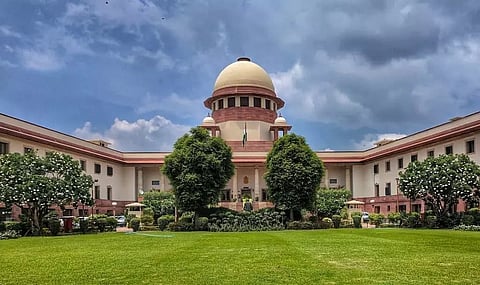
On February 28, the Supreme Court had observed that the level of discourse between a Chief Minister and the Governor must not degenerate into a "race to the bottom", which could jeopardize the implementation of constitutional values and the affairs of the nation.
It stressed that the Governor has to comply with the constitutional obligation to summon the House for its budget session in terms of the advice that is tendered by the council of ministers.
The top court was called upon to decide a confrontation between Punjab Chief Minister Bhagwant Mann and Governor Banwarilal Purohit over summoning the budget session in the state.
According to Article 200, when a bill passed by the legislature of a state is presented to the governor, he has four options: (a) he assents to the bill; (b) he withholds assent; (c) he reserves the bill for the consideration of the president; or (d) he returns the bill to the legislature for reconsideration.
The first proviso says that as soon as the bill is presented to the governor, he may return the bill to the legislature (if it is not a money bill) and request the legislature to reconsider it. The governor can also recommend introducing amendments or changes as he thinks appropriate. If, on such reconsideration, the bill is passed again, with or without amendments, and is presented to the Governor for assent, he has to accord his assent.
This means the Governor should exercise one of the above options for the legislative process to achieve finality, and in the event of a delay, the constitutional scheme gets disrupted.
Article 174 of the Constitution, coupled with a series of apex court judgments, has laid down that the governor must act on the aid and advice of the council of ministers. In the Punjab government-Governor row, the apex court had observed that there can be no manner of doubt that the authority that is entrusted to the Governor to summon the House or each House of the legislature of the state is to be exercised on the aid and advice of the council of ministers.
"The governor was plainly bound by the advice tendered to him by the council of ministers," the bench had observed.
The Supreme Court had examined the powers and functions of the governor in the Shamsher Singh vs. State of Punjab (1974) case. The apex court had held that the governor can act only on the aid and advice of the council of ministers, and executive powers -- which are vested in the elected government -- cannot be enjoyed by the governor.
In the Nabam Rebia vs. Deputy Speaker (2016) case, the Supreme Court emphasized that the governor can act only on the advice of the council of ministers.
In January 2013, upholding the appointment of Justice R.A. Mehta as Gujarat Lokayukta by Governor Kamla Beniwal, the apex court said: "It is evident that the Governor enjoys complete immunity under Article 361(1) and that under this, his/her actions cannot be challenged for the reason that the Governor acts only upon the aid and advice of the council of ministers. If this is not the case, democracy itself would be in peril."
"The Governor is not answerable to either the House of the State or Parliament or even to the council of ministers, and his or her acts cannot be subjected to judicial review. In such a situation, unless he/she acts upon the aid and advice of the council of ministers, he/she will become all powerful, and this is an antithesis to the concept of democracy," it added. (IANS)
Also Watch:
