
- Home
- Live Blog
- Breaking News
- Top Headlines
- Cities
- NE News
- Sentinel Media
- Sports
- Education
- Jobs
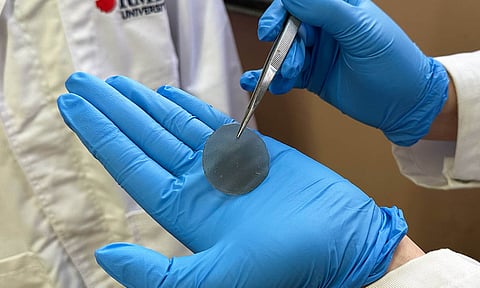
Researchers at RMIT University have developed a smart wound dressing that can both monitor a wound for signs of infection and deliver treatment — simultaneously — using a single, simple platform.
The breakthrough could prove significant for the management of chronic wounds, which place a heavy and ongoing burden on healthcare systems worldwide.
Also Read: Scientists discover why some wounds refuse to heal
Smart wound dressings that either monitor infections or deliver therapeutic agents have existed separately in research settings for some time.
The challenge has always been combining both functions into one dressing without making it prohibitively complex or expensive to produce — a barrier that has kept most lab prototypes from ever reaching patients.
RMIT's new approach addresses that problem directly.
The research team embedded tiny multi-functional nanoparticles — called carbon dots — into a hydrogel dressing material.
Carbon dots are biocompatible, carbon-based nanoparticles that can perform two distinct roles at once: imaging and sensing changes within a wound, and acting as therapeutic artificial enzymes (known as nanozymes) to combat inflammation.
Here is what happens in practice:
When a wound becomes infected, its pH level changes
The dressing detects this change and visibly shifts colour, readable by a standard smart device
Once infection is detected, the system automatically releases nanozymes into the wound to begin promoting healing
Clinicians or patients can also manually trigger additional nanozyme release simply by applying gentle pressure to the dressing
RMIT PhD candidate and lead study author Nan Nan said the real-time capability of the patch could meaningfully change how chronic wounds are managed.
She noted that catching infection at the earliest possible stage is critical in chronic wound care, and described the system as a potential game-changer for healthcare.
Nan also highlighted the practical simplicity of the fabrication process, saying the use of medically ready materials like hydrogels makes the dressing easy to produce at scale — with strong potential for commercial translation.
Dr Haiyan Li, Senior Lecturer at RMIT's School of Engineering and a collaborator on the project, said the innovation tackled the core reasons why smart dressings rarely make it out of the lab.
She pointed out that most research-stage dressings rely on complex designs or costly sensing systems that make clinical translation difficult. Their design, she said, integrates sensing and dual-mode therapeutic functions into a single streamlined dressing — and in doing so, has also defined clear design rules for future smart wound patches.
Chronic wound care — covering conditions like diabetic ulcers, pressure sores, and post-surgical wounds — demands constant monitoring and frequently changing treatment approaches.
A dressing that responds autonomously to infection signals, while remaining simple enough to manufacture at commercial scale, could reduce both the clinical workload and the cost burden associated with long-term wound management.
The research has been published and is attracting attention for its potential to bridge the persistent gap between laboratory innovation and real-world medical application.
