
- Home
- Live Blog
- Breaking News
- Top Headlines
- Cities
- NE News
- Sentinel Media
- Sports
- Education
- Jobs
Written by Harsha Hazarika
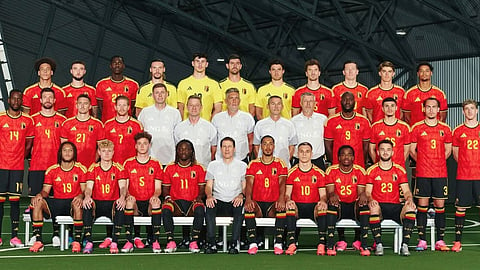
When we think of football powers, our minds instinctively travel to Brazil, Germany, Argentina, Spain or Portugal. Belgium rarely enters that conversation. Yet, quietly and without much fanfare, the Red Devils have achieved something remarkable. Their qualification for the 2026 FIFA World Cup marks Belgium's seventh consecutive appearance at a major international tournament which stretches from the 2014 World Cup through Euro 2024 and now to North America in 2026.
What fascinates me is not the statistic itself, but what the statistic reveals. Sustained success is rarely about a single golden moment. It is about successful succession. For nearly a decade, Belgium's identity was inseparable from its celebrated "Golden Generation" which included the likes of Kevin De Bruyne, Romelu Lukaku, Thibaut Courtois, Eden Hazard and Vincent Kompany. They transformed a talented footballing nation into a global contender and reached the pinnacle of their journey with a third-place finish at the 2018 World Cup.
Yet international football is full of cautionary tales. Great teams often struggle to survive the departure of iconic players. The cycle is familiar: a generation rises together, reaches its peak and gradually fades. The years that follow are often marked by uncertainty and decline. Belgium understood that danger better than most.
For much of the past decade, the Belgian Football Association's challenge was never simply producing outstanding players. It was producing enough of them, often enough, to ensure that success did not end when a handful of stars retired. The evidence now suggests they may have succeeded. Qualification for the 2026 World Cup extends a remarkable period of consistency that began more than a decade ago. Belgium is no longer the ambitious outsider attempting to join football's elite. It has become one of the few nations expected to qualify for major tournaments as a matter of routine.
More importantly, that consistency has outlasted coaches, systems and even generations. The names have changed. The expectations have changed. Belgium remains.
The most visible symbols of the old era are still present. De Bruyne remains the team's creative reference point. Lukaku continues to lead the line. Courtois remains among the finest goalkeepers in world football. But around them, a different team is beginning to emerge.
The leadership baton has gradually passed to players such as Youri Tielemans, while Jeremy Doku and Amadou Onana represent the new face of Belgian football. None of them are being asked to replicate the Golden Generation. Their responsibility is more complicated than that. They must ensure Belgium's story continues after it.
What makes Belgium's transition particularly striking is that it has not been dramatic or revolutionary. Instead, it has unfolded gradually, almost understatedly. Belgium has avoided the collapse that so often follows the departure of a celebrated generation. Rather than searching desperately for replacements, the national team appears to have been preparing for this moment years in advance.
That preparation is perhaps most visible in goal. For years, Belgian supporters have enjoyed the luxury of watching Thibaut Courtois guard their net. The Real Madrid goalkeeper has been one of the defining players of his era and remains among the world's elite shot-stoppers. Yet among the names travelling to the World Cup is a goalkeeper who may represent Belgium's future.
Senne Lammens may not yet command headlines, but his journey reflects the strength of Belgium's footballing structure. Having developed within the Belgian system before earning a move to Manchester United, the young goalkeeper now finds himself sharing a dressing room with the very players he once watched as a supporter. In many ways, that image captures Belgium's broader transition.
For goalkeepers, perhaps more than any other position, development is built on patience. They learn through observation, training sessions and quiet moments on the sidelines. They study positioning, decision-making and composure. They wait for opportunities that often arrive much later than they do for outfield players. Lammens represents that process: not merely the emergence of a talented goalkeeper, but the continuation of a carefully sustained footballing culture.
There will, inevitably, be discussions about tactics, group-stage opponents and Belgium's chances of progressing deep into the tournament. Those conversations are unavoidable. Yet they may not be the most revealing ones.
The more interesting question concerns what Belgium becomes after this World Cup. Will the nation continue to produce players capable of competing at the highest level? Can it remain relevant once the generation that transformed its reputation finally departs?
The answers may not arrive immediately. They may emerge gradually over the next four years through players such as Lammens, Doku and Onana. That is why Belgium's 2026 World Cup matters. Not because it represents the end of the Golden Generation, but because it offers the clearest glimpse, yet of what comes next.
Somewhere in the Belgian dressing room this summer, Kevin De Bruyne will lace up his boots for what could be his final World Cup. A few seats away, Senne Lammens will prepare for his first.
One represents the generation that changed Belgian football forever. The other belongs to the generation tasked with carrying it forward. Between them lies the real story of Belgium's 2026 World Cup: not merely a quest for results or silverware, but the quiet passing of a torch from one era to another.
The writer can be reached at Insta ID: Harsha_hazarika
