
- Home
- Live Blog
- Breaking News
- Top Headlines
- Cities
- NE News
- Sentinel Media
- Sports
- Education
- Jobs
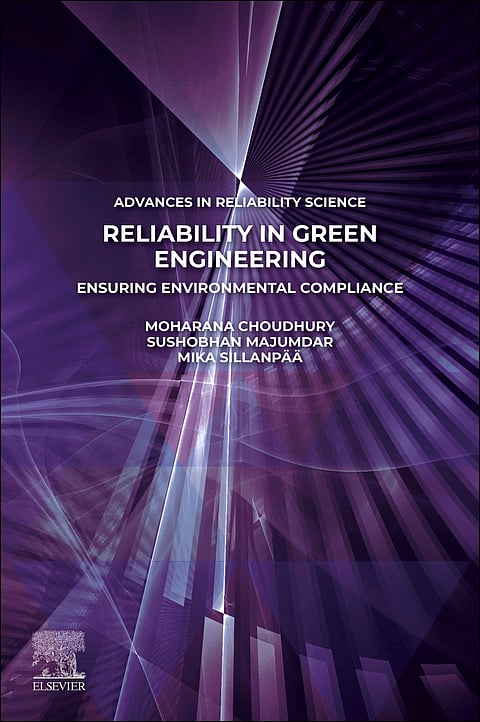
Guwahati: A new international edited volume, Reliability in Green Engineering: Ensuring Environmental Compliance, has been published by renowned publication Elsevier, one of the world's leading academic and scientific publishers. The book brings together contemporary perspectives on green engineering, reliability engineering, environmental compliance, sustainable technologies and regulatory frameworks, offering an interdisciplinary resource for engineers, environmental professionals, researchers, academics and policymakers.
The book is edited by Moharana Choudhury, Sushobhan Majumdar, and Professor Mika Sillanpää, bringing together expertise from India and South Africa. The volume is part of Elsevier's Advances in Reliability Science series and carries ISBN 978-0-443-36448-8.
Linking Reliability, Sustainability and Environmental Responsibility
The book addresses an increasingly important challenge in modern engineering: how engineering systems and technologies can remain reliable and efficient while also meeting environmental and sustainability objectives.
Reliability in Green Engineering: Ensuring Environmental Compliance provides a comprehensive examination of the relationship between green engineering principles, reliability, and environmental compliance. It explores how reliability considerations can be incorporated into sustainable engineering practices while helping organizations navigate complex environmental standards and regulatory requirements.
The volume covers a broad range of themes, including green engineering principles, reliability engineering, renewable energy systems, eco-friendly design, life-cycle analysis, risk management, environmental impact assessment, regulatory frameworks, compliance monitoring, environmental ethics, and emerging approaches to sustainable engineering.
The editors emphasize the practical dimension of these subjects through case studies, real-world examples and discussions of strategies for improving reliability while maintaining environmental responsibility.
Three Internationally Connected Editors
The book reflects an international editorial collaboration involving researchers and academics from India and South Africa.
Moharana Choudhury
Environmental Research and Management Division, Voice of Environment (VoE), Guwahati, Assam, India
Moharana Choudhury is a prominent Indian researcher and environmentalist associated with the Environmental Research and Management Division of Voice of Environment (VoE), Guwahati, Assam. His professional work focuses on environmental research, management, sustainability, waste management, and environmental conservation. Choudhury has more than 14 years of experience in environmental research and services and has authored or edited numerous books, journal articles and book chapters. His professional and ground-level activities also include environmental conservation initiatives, environmental education, research, and public awareness. His involvement as an editor places an environmental research perspective at the heart of the volume, particularly in connecting engineering reliability with environmental sustainability and compliance.
Sushobhan Majumdar
Department of Geography, Pandit Raghunath Murmu Smriti Mahavidyalaya, Jambani, Bankura, West Bengal, India. Sushobhan Majumdar is affiliated with the Department of Geography, Pandit Raghunath Murmu Smriti Mahavidyalaya, Jambani, Bankura, West Bengal, India. His contribution to the editorial team brings an interdisciplinary perspective on geography and the environment to the book.
Professor Mika Sillanpää
Department of Chemical Engineering, School of Mining, Metallurgy and Chemical Engineering, University of Johannesburg, Johannesburg, South Africa
Professor Mika Sillanpää is a prominent academic and researcher at the University of Johannesburg, South Africa. His research interests include chemical treatment in environmental engineering, environmental monitoring and resource recovery from waste streams.
His participation provides the book with strong expertise in environmental engineering, chemical treatment technologies and resource recovery, strengthening its international and multidisciplinary character.
Four Major Sections Cover the Green Engineering Landscape
The book is organized into four broad sections.
Section I – Fundamentals of Green Engineering and Reliability establishes the conceptual foundation by examining green engineering principles, reliability engineering, sustainability, and environmental compliance.
Section II – Integrating Reliability into Green Engineering Practices explores renewable energy systems, eco-friendly design methodologies, life-cycle analysis, and risk management strategies.
Section III – Ensuring Environmental Compliance in Engineering Projects focuses on regulatory frameworks and standards, environmental impact assessment, compliance monitoring and reporting, and legal and ethical considerations.
Section IV – Case Studies and Best Practices in Reliability Engineering brings together lessons from real-world projects, innovative approaches to environmental compliance, and future trends in green engineering and reliability.
The volume contains 16 chapters, followed by an index, providing a broad examination of the subject from foundational concepts to practical applications and future directions.
Why the Book Matters
As industries and governments increasingly move toward low-carbon, resource-efficient and environmentally responsible development, the reliability of green technologies has become a critical consideration.
Renewable energy systems, sustainable infrastructure, waste-management technologies, environmental monitoring systems and other green technologies must not only be environmentally sound but also dependable, resilient and capable of meeting regulatory requirements.
The book therefore addresses the intersection of three important priorities:
Reliability + Green Engineering + Environmental Compliance
This integrated approach can be particularly relevant for engineers designing sustainable infrastructure, environmental professionals managing compliance, policymakers developing environmental standards, and researchers working on emerging green technologies.
A Timely Contribution to Sustainable Engineering
The publication arrives at a time when environmental regulations and sustainability expectations are becoming increasingly important across engineering and industrial sectors. The book's emphasis on regulatory compliance, risk management, life-cycle thinking and reliable green technologies makes it relevant to contemporary debates surrounding sustainable development. Rather than treating environmental compliance as a separate regulatory obligation, the volume presents it as an integral component of reliable and sustainable engineering practice. The editors' international collaboration also demonstrates the increasingly interdisciplinary nature of environmental and engineering research, connecting perspectives from environmental science, geography, chemical engineering and reliability engineering.
