
- Home
- Live Blog
- Breaking News
- Top Headlines
- Cities
- NE News
- Sentinel Media
- Sports
- Education
- Jobs
Partha Sarathi Das
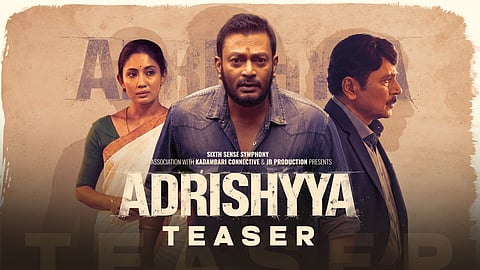
Jatin Bora and Tapan Das share the screen in a thriller that smuggles grief, guilt and the silent violence of displacement into an out-and-out crowd-pleaser, and never once loses its footing on the tightrope. Assamese cinema has rarely looked so confident.
It begins with fire. A body in a pit, somewhere deep in a jungle that has clearly kept worse secrets, and flames that rise without hurry, as if they have all night. It is the oldest hook in the thriller playbook, and director Samujjal Kashyap knows it. What Adrishyya does next is the real sleight of hand: it makes you forget you were ever promised a thriller at all.
The film that follows does not initially focus on a dead body. It is about a living one, barely alive. Jatin Bora plays Prajapati, a man who reads poetry on the periphery of a life that has no margins left. He loses his mother to an accident, and with her goes the family's income-earning vehicle, always the first thing to be bartered when money was urgently needed. Gig work follows, then more gig work: the old Indian purgatory of driving for anyone who knows a contact, combined with the new reality of apps, ratings, and rent. Hovering over all of it is the fear of displacement, that peculiarly urban dread of waking up one morning to discover that the ground beneath you belonged to the government all along.
The mother character represents one of the film's many masterstrokes. Through her, Adrishyya sketches the generational ache of never owning a house, a grief handed down like an heirloom nobody asked for. She does not specify about it. She simply carries it on her shoulders, in her silences, in the way she looks at walls she cannot call her own. When she is gone, the ache does not leave. It moves in with her son.
His wife, played by Priyam Pallabee, is the perfect foil: grounded where he drifts, practical where he is poetic, a support system that refuses to become a prop. She is the reason we believe Prajapati can survive the avalanche of misfortunes the screenplay pours on him, one after another, until a sliver of stability arrives in the form of a job offer in the mansion of Tapan Das.
And here the film changes keys.
Tapan Das plays Aniruddha, a man who lives at the very edge of lunacy and seems to enjoy the view. He is eccentric, mercurial, and maddeningly unpredictable, the kind of employer who offers you a glass of whisky and a riddle simultaneously. Das plays him with a feast of idiosyncrasies: the deliberate pauses, the hysterical laughter, and the dialogue weighed like a coin tested between the teeth. The audience fumbles, bewildered by his antics, unable to categorise him, and that is precisely the point. When the film finally reveals the backstory that pushed him to this precipice, the antics we laughed at curdle into something heartbreaking. The comedy, it turns out, was only Grief wearing a funny hat. It may be his best work, a performance of outstanding nimbleness, loss, and lightness.
Consider what Adrishyya is attempting: Urban displacement, financial mobility, middle-class aspirations, class struggle, the daily fight for sustenance, guilt, grief, loneliness, and, most delicately, suicide. Any one of these could sink a lesser film into the swamp of the merely important. Adrishyya weaves all of them into an out-and-out commercial entertainer and walks that tightrope with the conviction of someone who never once looks down. The film never spoon-feeds. It never lets you forget, either.
Much of this rests on Samujjal's astute direction, which understands where laughter comes from. The humour here is never bolted on; it springs from the demands of each scene, from character rather than convenience. Even as the narrative explores darker themes (the setup, the scheming, the meticulous planning of a murder), the jokes remain seamlessly integrated. They feel like nerves, and the hall answers them with bursts of laughter. Then there are the songs. For years, the song in Assamese cinema has been a kind of interlude within the film, a place for the audience to loosen up and stretch its legs. Adrishyya will have none of it. Its songs push the story forward and add nuance to each character's arc and ambition so that a melody becomes a murder and a montage becomes a motive. It sounds like a small thing. It is not. This is a film rewriting the grammar of our film industry.
Every astute thriller, in any language, knows the value of a decoy: characters who lead us gently down the wrong path so that the truth can ambush us later. Adrishyya deploys them with relish. Munni, played by Pranami Bora, and Pehi, played by Jolly Laskar, add layer upon layer of intrigue and drama, each a door that might open onto the answer or yet another corridor. Dr Lima Das, Tapan Das' wife, brings a gravitas and pathos that anchor the film's grief; her sorrow has refused to forgive one mistake for years. It doesn't need to raise its voice to fill a room; when it does, it's to be heard, even in someone else's fever dream.
But the film's sharpest joke is on itself. At one point, Prajapati is asked to lie that he works for, of all people, Jatin Bora. This gag also serves as a riddle: the superstar "Jatin Bora" is, after all, a persona created by the man Jatin Bora, who in this very scene is pretending to be someone else. Elsewhere, the film mines humour from its two superstars' supposed 'over-acting', turning their one-upmanship into a running joke at their expense. The fact that two of the biggest names in Assamese cinema agreed to be the punchline is a testament to the director's skill. That they are funnier, for it is the loot.
The meta-humour extends to Himanshu Prasad Das, who plays an activist of sorts, raging against a system that refuses to award land pattas. Anyone who knows him as a fearless voice of conscience and his real-life institution of dissent, System Birodhi Xotta, will catch the wink, and the film showcases it with affection rather than mockery.
And then there is Pranami Bora, the film's most delightful revelation. Her character is all mystery, intrigue and sinister intent, the kind of author-backed role that tempts actors into histrionics. She refuses the temptation every single time. Her menace lurks at the edges, her confidence steelier still, and it is this restraint that makes her impossible to look away from.
Look closer and you notice that the film's real engines are its women. Kashyap and Rajdweep refuse to treat them as emotional accessories to the hero's journey; they are women of steel and stealth, the ones who propel, complicate and, now and then, threaten the plot itself. The mother's longing for a permanent home becomes her son's near-desperate resolve to secure one. Munni drifts at the edge of Prajapati's working life until she finds her voice, and with it ambitions sinister enough to endanger the elaborate conspiracy he hatches with Aniruddha. Priyam Pallabee's Maya, a veritable chameleon, stands shoulder to shoulder with her husband through every reversal; then, in a dream sequence, she transforms almost beyond recognition into a glamorous avatar. Her large, expressive eyes do the work that dialogue cannot. It is a rare pleasure to see women written to surprise us rather than to serve the convenience of the men around them.
By the end, the arcs that need closing are closed, and the ones left ambiguous are left so by design rather than by accident: a director trusting the audience to carry a few questions home. The fire from the opening scene has long extinguished. What lingers is warmth.
By the time the credits roll, you realise you have watched both superstars of Assamese cinema in full bloom, having fun, taking risks, and gifting us a film that is at once a thriller, a tragedy and a comedy of errors and omissions about who gets to own the ground they stand on. Jatin Bora brings a star's assurance to an ordinary man's vulnerability; Tapan Das finds humour in eccentricity and heartbreak in the deepest guilt; and neither has to carry the film alone. Together, they prove that Assamese cinema can be commercially engaging and artistically ambitious at once. Adrishyya means invisible. It deserves the brightest of spotlights and millions watching in awe.
