
- Home
- Live Blog
- Breaking News
- Top Headlines
- Cities
- NE News
- Sentinel Media
- Sports
- Education
- Jobs
Staff Reporter
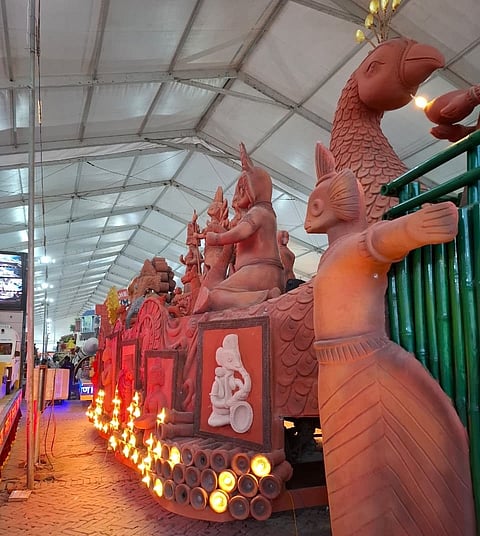
GUWAHATI: The Assam tableau for the upcoming Republic Day parade, which was showcased to media persons at the Rashtriya Rangshala Camp in New Delhi on Thursday, offered a first glimpse of the state's rich terracotta tradition centred on Asharikandi, a celebrated craft village in the Dhubri district in Assam.
Nodal Officer Bikram Newar and officials from the Cultural Affairs Department, Government of Assam, were present on the occasion.
At the heart of the tableau is a towering terracotta doll carrying earthen lamps arranged in a circular pattern, forming a visually striking focal point that symbolizes light, continuity and tradition. On either side of the tractor-mounted structure, earthen sarai are displayed along bamboo fencing, highlighting Assam's abundant bamboo resources and their contribution to the region's socio-economic development.
The trailer section of the tableau takes the form of a graceful Mayurpangkhi boat, evoking Assam's deep-rooted riverine heritage. Artisans are depicted shaping hiramati (clay) into divine forms of gods and goddesses such as Ganesh, Kartik, Durga, Lakshmi and Saraswati, presenting the living process of terracotta craftsmanship.
At the rear end, a traditional pall (sail canvas) enhances the authentic aesthetic of the boat, reinforcing the central role of rivers in Assam's cultural life.
Conceptualized around the theme of Atmanirbhar Bharat, the tableau portrays Asharikandi as a symbol of self-reliance achieved through cultural entrepreneurship. The village stands as an example of how age-old skills, when preserved and innovatively presented, can sustain livelihoods and contribute to a self-sustaining local economy.
Asharikandi is widely recognized as the largest Assamese terracotta and pottery craft cluster in India, located in the Dhubri district of Assam. The village is home to numerous artisan families who have practiced traditional pottery and terracotta craftsmanship for over a century, passing down their skills through generations.
The roots of this craft tradition date back to the early 19th century, when families from the pottery community migrated from East Bengal (present-day Bangladesh) and settled in Asharikandi. Over time, they preserved their ancestral occupation while infusing innovation and local cultural influences, giving birth to a distinct Assamese terracotta art form.
Among the many artisans who shaped Asharikandi's identity, the late Sarala Bala Devi played a pivotal role in bringing national recognition to the village. She received the National Award for Terracotta Craft in 1982 for her iconic Hatima doll - a graceful female figure holding a child on her lap - which became a defining symbol of the craft village.
In a major boost to its heritage value, the terracotta crafts of Dhubri district received the Geographical Indication (GI) tag in March 2024, becoming the sixth traditional craft from Assam to earn this prestigious recognition. The GI status has further cemented Asharikandi's position as a national centre of terracotta excellence, highlighting its cultural, historical and economic significance.
Also read: Guwahati: Public service month launched ahead of 77th Republic Day
