
- Home
- Live Blog
- Breaking News
- Top Headlines
- Cities
- NE News
- Sentinel Media
- Sports
- Education
- Jobs
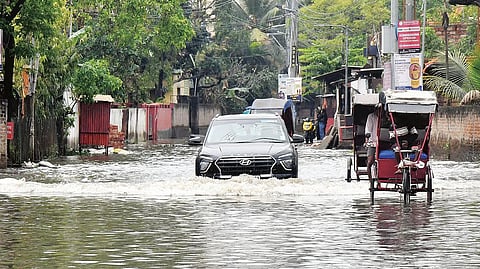
GUWAHATI: Why does Guwahati continue to suffer from artificial flooding every monsoon? While authorities point to civic irresponsibility, many residents argue that repeated assurances have not translated into lasting solutions on the ground.
Artificial floods across the city are no longer confined to a few low-lying pockets—they have become a citywide concern. Urban planners and officials stress that clogged drains, indiscriminate garbage dumping and unplanned construction contribute significantly to waterlogging. However, citizens say the issue runs deeper than public behaviour alone.
Officials from the Guwahati Municipal Corporation (GMC) maintained that extensive efforts are underway. A senior GMC engineer stated, “We have been carrying out regular desiltation of drains and improving waste collection systems. However, if residents continue to dump garbage into drains, the problem will persist.”
Another official added that infrastructure upgrades are in progress but will take time. “Major drainage projects require coordination across departments. We are doing our part, but the scale of the challenge is huge,” the official said.
Despite these claims, frustration among residents is growing. Many allege that authorities often shift blame rather than addressing systemic gaps.
Anjali Baruah, a resident of Anil Nagar, said, “Every year we hear the same excuse—that people are throwing garbage. But what about broken drains and unfinished projects? The government should take responsibility too.”
Hirok Kalita, who lives in Nabin Nagar, echoed similar concerns. “They say work is ongoing, but during every heavy rain, our homes get flooded. It feels like temporary fixes, not permanent solutions.”
Meanwhile, college student Gautam Das pointed to a lack of accountability. “We understand that citizens have a role, but the government cannot keep using that as an excuse. There needs to be better planning and proper monitoring.”
Experts suggest that tackling artificial flooding in Guwahati requires a combined effort—strict enforcement against waste dumping, timely completion of drainage infrastructure and greater transparency from authorities.
As the monsoon approaches, the question remains whether the city can move beyond blame and take coordinated action. Until then, artificial flooding continues to reflect both civic lapses and administrative shortcomings.
Also Read: Highway Firm Gets Show-Cause Notice for Guwahati Waterlogging, But What About Other Agencies?
