
- Home
- Live Blog
- Breaking News
- Top Headlines
- Cities
- NE News
- Sentinel Media
- Sports
- Education
- Jobs
Guwahati: In an election season full of high-stakes contests, the No. 36 Guwahati Central constituency has quietly emerged as one of the most interesting races in the state. It is a seat where youth is taking on experience, regional identity is pushing back against national politics, and a door-to-door debutante is challenging a long-standing party machine.
At its core, the battle for Guwahati Central is a generational contest — and its outcome may say something larger about where urban Assam is headed.
Also Read: Sarma Campaigns in Sarthebari: Predicts BJP-AGP Victory
On one side is Vijay Kumar Gupta, the BJP's seasoned candidate who has served as the party's State General Secretary, Vice President, and a long-time core committee member. He represents continuity, organisational depth, and years of ground-level political experience.
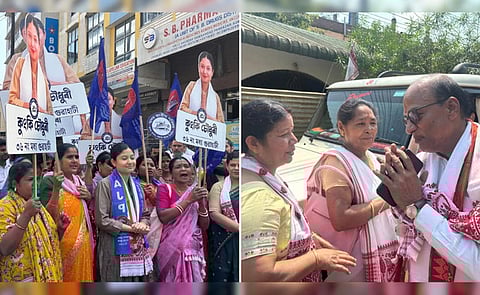
On the other is Kunki Chowdhury, 27, contesting on an Assam Jatiya Parishad (AJP) ticket and the youngest candidate in the fray. An alumna of Narsee Monjee Institute of Management Studies and University College London, she represents a deliberate push by the AJP to bring educated, professional voices into electoral politics.
The contrast could hardly be sharper.
Chowdhury's entry into politics was not planned. For five to six years before this election, she was managing her family's non-profit society, which runs several educational institutions across Assam.
"I never imagined entering politics. When the opportunity came from AJP, I felt it was the right moment to step forward," she said.
Her campaign has zeroed in on the basics that she argues have been overlooked for too long. "Garbage management, drainage, primary healthcare, and government schools have seen little real improvement and require better planning and resource allocation," she noted.
Positioning herself as a Gen-Z candidate, she made a pointed observation about the gap between those in power and the people they serve. "The older generation has contributed significantly, but there is a growing gap between governance and the public. Young leaders can bring innovative solutions," she said.
To back that up, Chowdhury has launched the #KnockEveryDoor campaign — a door-to-door outreach initiative designed to listen to residents directly and share her development vision. The response on its opening day was described as positive, with coverage set to expand in the days ahead.
Gupta, meanwhile, has outlined a detailed development agenda that blends immediate fixes with longer-term ambitions for the constituency.
"My focus after winning will be to address the drinking water crisis and ensure street lighting in every by-lane," he said — targeting two of the most common complaints from residents in urban Guwahati.
He also proposed developing Adingiri Hills into a tourist destination, building playgrounds in every ward, and improving road infrastructure across the constituency. On broader issues, Gupta stressed the need to tackle drug abuse, reduce unemployment, and improve the quality of education and healthcare available to residents.
The Guwahati Central contest is being watched not just for who wins, but for what the result reveals. A Gupta victory would suggest that organisational strength and established political networks still dominate in urban Assam. A Chowdhury win would signal something more disruptive — that a credentialed young candidate running on local issues can break through even in a seat with complex demographic dynamics.
Either way, the race has already made Guwahati Central one of the defining contests of the 2026 Assam Assembly elections.
