
- Home
- Live Blog
- Breaking News
- Top Headlines
- Cities
- NE News
- Sentinel Media
- Sports
- Education
- Jobs
STAFF REPORTER
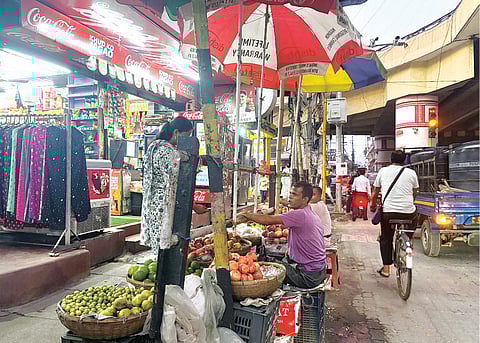
GUWAHATI: Despite repeated eviction drives by the Guwahati Municipal Corporation (GMC), illegal roadside markets continue to dominate several key areas of the city, causing traffic congestion, pedestrian inconvenience and growing civic concerns. Areas such as Ganeshguri, Beltola, Bhangagarh, Paltan Bazar and Zoo Road remain heavily encroached upon by unauthorized street vendors occupying footpaths and roadside spaces.
In recent weeks, the GMC has intensified eviction operations in localities including Bhangagarh, Ulubari, Kalapahar and Lachit Nagar, aiming to clear footpaths and public spaces. However, residents allege that vendors often return shortly after the drives, raising questions about the long-term effectiveness of enforcement measures.
Encroachment of footpaths has made walking unsafe and inconvenient for pedestrians, forcing many onto busy roads. Traffic congestion has worsened in market-heavy zones, particularly during peak hours. Residents have also complained about unhygienic conditions in several street food markets, citing poor garbage disposal and a lack of basic sanitation facilities.
A resident of Beltola pointed out that child labour continues unchecked in some street food markets due to inadequate surveillance and the absence of proper licensing mechanisms. "Children are often seen assisting at stalls, which is a serious legal and social concern," the resident said.
Another resident highlighted the absence of public toilets, especially for women vendors, calling it a major health and safety issue. "Despite repeated Swachh Bharat campaigns, there are no proper toilet facilities for vendors or customers in many areas," the resident added.
GMC officials maintain that steps are being taken to address the issue in a structured manner. The civic body has identified locations for setting up designated vending zones and has already approved 83 such zones across the city, with more proposals under process. The GMC has also finalized standard designs for vending carts in an effort to bring uniformity and improve hygiene and aesthetics.
Officials argue that once fully implemented, the vending zone policy will help strike a balance between urban order and the livelihoods of street vendors.
Guwahati's streets remain a vibrant mix of life, chaos and survival. Street vendors, selling everything from food to daily essentials, form an integral part of the city's informal economy and provide affordable services to thousands of residents. Yet, their presence is increasingly viewed through the lens of urban disorder and congestion.
The situation reflects Guwahati's broader struggle with rapid urbanization. While eviction drives address immediate concerns, long-term solutions lie in the effective implementation of vending zones, proper licensing, sanitation facilities and regular monitoring.
For vendors, the issue goes beyond space-it is about survival, dignity and the right to earn a living. Urban planners and authorities face the challenge of ensuring that development does not come at the cost of livelihoods.
As Guwahati moves forward with its development agenda, experts and residents alike stress that street vendors should not be treated as obstacles to progress, but as essential contributors to the city's economy and cultural fabric. Balancing their needs with planned urban growth, they say, is not just a policy imperative but a moral responsibility.
Also read: GMC takes action against storage of construction materials on roadside
