
- Home
- Live Blog
- Breaking News
- Top Headlines
- Cities
- NE News
- Sentinel Media
- Sports
- Education
- Jobs
STAFF REPORTER
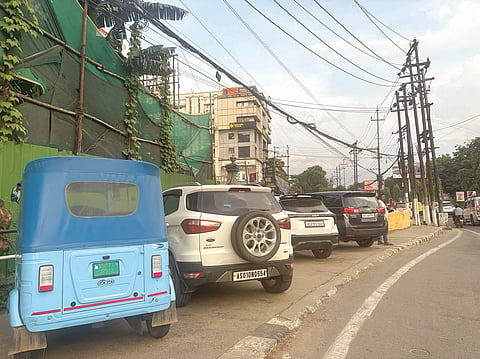
GUWAHATI: Who is responsible for keeping Guwahati’s footpaths free for pedestrians? The question is increasingly being raised as two-wheelers and other vehicles continue to occupy pavements and spaces covering drains, including areas close to Dispur, leaving pedestrians to negotiate narrow and unsafe stretches.
The problem, however, is not confined to Dispur. Across Guwahati, footpaths meant for pedestrians have increasingly turned into informal parking spaces, while roadside vendors and makeshift shops further squeeze the limited walking space available to the public.
Despite repeated drives by the Guwahati Municipal Corporation (GMC) and instructions regarding parking charges in designated areas, violations continue, raising questions over the effectiveness of enforcement in a city that frequently projects itself as a “smart city”.
When contacted, a traffic official at Dispur Police Station said enforcement against parking on footpaths did not fall under the traffic police’s jurisdiction.
“We alert vehicle owners not to park on footpaths, but they often park and move on. Enforcement in such cases should be done by the GMC,” the official said. The GMC, meanwhile, acknowledged the issue but cited a shortage of manpower as a major hurdle in keeping a constant watch over violations.
“If anyone files a complaint, we take swift action. However, due to shortage of manpower, it is challenging to monitor the situation throughout the city,” a GMC official said. The lack of regular enforcement has left pedestrians questioning who should ultimately be held accountable when public infrastructure is repeatedly misused.
“This is supposed to be a smart city, but where is the basic planning for pedestrians? We cannot even walk freely on footpaths because vehicles are parked everywhere. Authorities come for drives, remove the encroachments and then everything returns to normal,” said a pedestrian from Dispur.
Another pedestrian said, “If the authorities know that parking on footpaths is illegal, why is there no permanent solution? Common people are forced to walk on the road, risking their lives. This shows a complete failure of civic management in a so-called smart city.” Urban planners and civic activists have repeatedly stressed that footpaths are essential pedestrian infrastructure and cannot be allowed to become extensions of parking areas or commercial spaces.
With the traffic police pointing to the GMC and the civic body citing manpower constraints, the larger question remains: who will take responsibility for ensuring that Guwahati’s footpaths remain footpaths?
ALSO Read: Green buses, grey areas: Guwahati commuters question uneven traffic enforcement
