
- Home
- Live Blog
- Breaking News
- Top Headlines
- Cities
- NE News
- Sentinel Media
- Sports
- Education
- Jobs
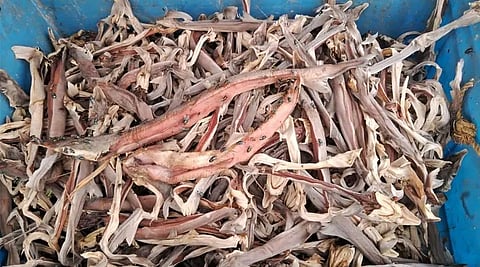
KOCHI: A growing global demand for shark fins, corals and other protected marine species has pushed Indian scientists, conservationists and enforcement agencies to seek a new science-backed strategy to curb illegal marine wildlife trade.
At a national workshop hosted by ICAR-Central Marine Fisheries Research Institute here, experts stressed that marine conservation can no longer be viewed solely as a policing issue, but must integrate science, technology, fisheries management, and coastal community participation. The three-day capacity-building workshop brought together enforcement officials, marine scientists, conservation experts and policymakers from across the country to strengthen India’s response to marine wildlife crime.
Participants warned that illegal trade networks targeting marine species are becoming increasingly sophisticated, demanding improved surveillance, scientific identification, and coordinated interstate enforcement.
According to studies presented at the workshop, India recorded 17 seizures involving illegal shark derivatives between 2010 and 2022, with shark fins accounting for nearly 82 per cent of all confiscated material.
More than 15.8 tonnes of shark derivatives were seized during the period, with Tamil Nadu identified as a major hotspot.
Divisional Forest Officer Manu Sathyan said identifying protected marine species remains one of the biggest challenges in wildlife crime investigations.
He underlined the importance of collaboration between enforcement agencies and scientific institutions for accurate species identification and forensic documentation. (IANS)
