
- Home
- Live Blog
- Breaking News
- Top Headlines
- Cities
- NE News
- Sentinel Media
- Sports
- Education
- Jobs
Pallab Bhattacharyya
(Pallab Bhattacharyya is a former director-general of police, Special Branch and erstwhile Chairman, APSC. Views expressed by him is personal. He can be reached at pallab1959@hotmail.com)
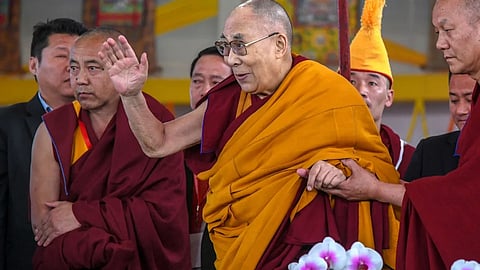
The upcoming succession of the 14th Dalai Lama is poised to become a pivotal geopolitical event of the twenty-first century. What seems to be the selection of a spiritual leader has, in reality, turned into a contest over legitimacy, sovereignty, and influence across Asia. Monasteries and theological debates no longer confine the question of who has the authority to recognise the next Dalai Lama. It has entered the arena of international diplomacy, where history, religion and statecraft intersect in ways that could reshape the political and spiritual landscape of Asia for decades to come.
At the heart of the issue lies a fundamental divergence of perspectives. The Dalai Lama has consistently maintained that the authority to identify his reincarnation rests solely with the established traditions and institutions of Tibetan Buddhism. He has even indicated that his successor may be born outside territories under Chinese control to ensure the continuity of an independent spiritual lineage. Beijing, however, asserts that the recognition of all Tibetan Buddhist reincarnations falls within the sovereign jurisdiction of the Chinese state under its legal framework governing religious affairs. To China, a viable succession solution does not exist in competing with China on its own terms. It is not merely a religious event; it is also a matter of national sovereignty and territorial integrity. To many followers of Tibetan Buddhism, it remains a sacred spiritual process beyond the reach of political authority.
This disagreement has transformed Buddhism into an unexpected theatre of strategic competition between Asia’s two dominant civilisational powers—China and India. Yet reducing the issue to a simple geopolitical rivalry would overlook a more complex reality. Both countries have deep historical connections with Buddhism, but they have chosen remarkably different pathways in engaging with the faith.
China’s approach deserves a careful and objective examination rather than ideological caricature. Over the past two decades, Beijing has crafted a comprehensive model of Buddhist statecraft. Instead of treating Buddhism solely as a matter of religious administration, China has incorporated it into its broader national strategy encompassing domestic governance, cultural diplomacy and regional influence.
Internally, Beijing’s policy is driven by the concept of the “Sinicisation of religion”—an effort to harmonise religious traditions with Chinese national identity, socialist values and political stability. The leadership believes that economic development and modernisation are essential for maintaining long-term stability in Tibet, viewing Tibetan Buddhism through the lens of national integration. Massive investments in roads, railways, airports, healthcare, education and urban infrastructure across the Tibet Autonomous Region are intended not only to improve living standards but also to strengthen the integration of the region with the rest of China. The state’s objective is to ensure that religious practice flourishes within a framework aligned with national priorities, thereby reducing the possibility of political separatism.
Whether one agrees with this approach or not, it reflects a coherent strategic vision rather than an ad hoc response. For Beijing, Buddhism represents an element of governance, social cohesion and national security as much as a spiritual tradition.
China has been equally methodical in extending this vision beyond its borders. Recognising Buddhism as one of Asia’s shared civilisational inheritances, it has invested heavily in cultural diplomacy. Through platforms such as the World Buddhist Forum, restoration of historic monasteries, support for Buddhist scholarship and integration of Buddhist heritage into the Belt and Road Initiative, China has sought to present itself as a leading patron of Asian civilisation. Investments in Lumbini in Nepal, support for heritage conservation in Sri Lanka and partnerships with Buddhist institutions across Southeast Asia demonstrate how infrastructure, culture and diplomacy have been woven together into a sophisticated instrument of soft power.
This strategy has yielded tangible dividends. For many developing countries, Chinese assistance has helped preserve religious monuments, improve connectivity and stimulate tourism. In the process, Buddhism has become an important component of China’s broader international engagement. Yet Buddhism’s enduring authority cannot. However, infrastructure alone cannot build Buddhism’s enduring authority. through infrastructure alone. The faith ultimately derives its legitimacy from its teachings, traditions and sacred geography. This is where India occupies a unique and irreplaceable position.
India is not merely another Buddhist nation; it is the birthplace of Buddhism itself. It was beneath the Bodhi Tree at Bodh Gaya that Siddhartha Gautama attained enlightenment. It was at Sarnath that he first expounded the Dharma. Nalanda became one of the world’s greatest centres of Buddhist learning, attracting scholars from across Asia centuries before the rise of modern universities. Kushinagar witnessed the Buddha’s Mahaparinirvana. Every major milestone in the Buddha’s earthly journey unfolded on Indian soil.
Modern India has added another important chapter to this legacy by providing refuge to the Dalai Lama and thousands of Tibetan refugees since 1959. Dharamshala has evolved into the principal global centre for preserving Tibetan Buddhist philosophy, scholarship and culture. This remarkable act of civilisational hospitality has earned India enduring goodwill throughout the Buddhist world.
Yet India has not always translated this unparalleled inheritance into sustained strategic influence. Buddhist diplomacy has often remained episodic, becoming prominent during moments of political friction with China rather than functioning as a long-term pillar of foreign policy. Despite significant improvements recently, the Buddhist Circuit continues to require world-class infrastructure, integrated tourism management, cutting-edge research institutions and greater international academic engagement if it is to realise its full potential.
India’s challenge is therefore not one of legitimacy but of leadership. Possessing the birthplace of Buddhism is an extraordinary advantage, but civilisational capital must be continually renewed through scholarship, accessibility and global engagement.
Competing with China on its own terms is not a viable solution. Competing with China on its own terms is not a viable solution. India is unable and unwilling to match China’s financial resources or infrastructure investments. Instead, it should build upon its own unique strengths.
First, India must consistently uphold the principle that religious succession belongs to religious institutions. Such a position is not directed against any particular country but flows naturally from India’s own constitutional commitment to freedom of religion and pluralism. By remaining a principled defender of spiritual autonomy rather than a partisan participant in religious disputes, India enhances both its credibility and its moral standing.
Second, the Buddhist Circuit should become one of the world’s finest examples of heritage-based international cooperation. Modern airports, high-speed rail connectivity, multilingual visitor facilities, digital archives, international universities, monastic exchange programmes and global research centres can transform India’s sacred geography into a vibrant ecosystem of pilgrimage, learning and cultural diplomacy.
Third, India should consciously broaden the scope of Buddhist engagement beyond geopolitics. Conferences on Buddhist ethics, climate resilience, mental health, conflict resolution, artificial intelligence and environmental stewardship would demonstrate the continuing relevance of Buddhist philosophy in addressing contemporary global challenges. Such initiatives would naturally attract scholars, monks and practitioners from every Buddhist tradition while reinforcing India’s image as a genuine custodian of the Dharma.
The wider Buddhist world offers an instructive example. Countries such as Thailand, Vietnam, Cambodia, Laos and Myanmar have largely resisted the temptation to view India and China through an either-or prism. Thailand draws spiritual inspiration from India’s sacred sites while welcoming Chinese investment. Vietnam maintains historical Mahayana links with China even as it deepens cultural cooperation with India. Cambodia and Laos similarly distinguish between economic engagement and spiritual identity. Rather than choosing sides, these nations have adopted a pragmatic policy of strategic hedging, preserving their autonomy while benefiting from engagement with both powers.
This balancing act carries an important lesson. Buddhism has historically flourished not through political domination but through cultural exchange, intellectual openness and mutual respect. The countries of Southeast Asia recognise that infrastructure and investment can coexist with independent spiritual traditions. They see no contradiction in accepting Chinese economic assistance while continuing to regard India as the spiritual cradle of the Dharma.
As the succession of the Dalai Lama approaches, it will inevitably influence the future of Buddhism in light of political realities. The approaching succession of the Dalai Lama will inevitably influence the future of Buddhism in light of political realities. by political realities. Yet the more profound question extends beyond the recognition of one spiritual leader. It concerns the very character of Buddhism in the twenty-first century. Will it remain a universal moral philosophy that transcends borders, or will it increasingly become entangled in contests of state power and strategic rivalry?
The answer depends not only on Beijing or New Delhi but also on the collective wisdom of the international Buddhist community. If China demonstrates the power of institutions, planning and investment, India embodies the timeless authority of sacred geography, pluralism and civilisational continuity. The future of Buddhism does not require competition between these strengths; instead, collaboration can enhance its development. The future of Buddhism can thrive without competition between these strengths. when determining the future of Buddhism. Competing between these strengths is unnecessary. Rather, it should be guided by the recognition that one of humanity’s greatest spiritual traditions is best served when political ambition yields to the universal values of compassion, wisdom and peace that the Buddha himself preached over twenty-five centuries ago.
The succession of the 14th Dalai Lama will undoubtedly mark the end of one historic era. It also presents Asia with a rare opportunity—to ensure that Buddhism continues to unite civilisations rather than divide them, serving not as an instrument of geopolitical rivalry but as a bridge of understanding across a rapidly changing world.
