
- Home
- Live Blog
- Breaking News
- Top Headlines
- Cities
- NE News
- Sentinel Media
- Sports
- Education
- Jobs
Justice Biplab Kumar Sharma
Former Judge, Gauhati High Court
Part XV of the Constitution of India deals with elections to Parliament
and to the Legislature of every state. While Article 324 thereunder vests the Election Commission with the superintendence, direction and control of elections, Article 327 empowers the Parliament to make provisions with respect to elections to legislature. Article 325 provides that a person shall be eligible for inclusion in any Electoral Roll or in any Special Electoral Roll, regardless of religion, race, caste, sex, or any of them. Article 326 says that elections to the House of the People (Lok Sabha) and to the Legislative Assemblies of states are to be on the basis of Adult Suffrage.
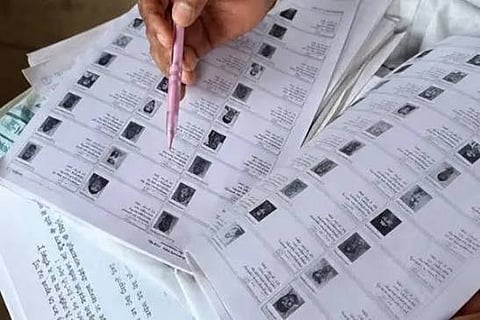
Special Intensive Revision (SIR) is a process undertaken to ensure the inclusion of only eligible voters and the exclusion of ineligible persons from the voter list, applying the test of rational nexus between the means adopted and the object sought to be achieved. The Election Commission of India has sparked extensive debate on the SIR of the Electoral Rolls. Some political parties and other organisations have taken the issue to the streets through agitation programmes. Simultaneously, legal proceedings have been initiated against the SIR, particularly concerning its implementation in the State of Bihar. Presently a proceeding relating to the conduct of the Chief Election Commissioner, allegedly in defiance of the opinions of the other two Commissioners in respect of the process and procedures of the SIR, is also pending in the Supreme Court of India.
The challenge to the said exercise is on the grounds of impermissibility to do so, falling back on Article 324, which vests in the Commission only the superintendence, direction and control of elections and not a freestanding reservoir of plenary power that could be invoked dehors the legislative framework under Article 327. It is argued that the powers of the Election Commission under Article 324 are meant to supplement rather than supplant the law.
It is also argued that the Commission, under the guise of an administrative exercise, has created an entirely new regime of enumeration, which has led to chaos and confusion, resulting in the illegal exclusion of eligible voters from the Electoral Rolls, while completely ignoring the fact that this area is already governed by parliamentary legislation enacted under Article 327, specifically the Representation of the People Acts of 1950 and 1951, as well as the Registration of Electors Rules of 1960. The basic foundation of the said argument is that once Parliament has legislated on the subject of electoral rolls, Article 324 cannot be invoked to supplant such a framework.
It is also argued that Section 21(3) of the RP Act allows the Commission to direct an SIR of an electoral roll only for a specific constituency or part of one, not statewide or nationwide. It is also argued that such an extraordinary measure can only be taken in exceptional circumstances and limited to a specific area. Another issue raised is that such an exercise, calling upon the already enrolled electors to re-establish their credentials through a new and onerous process, casts the burden upon them, having the potential of diluting the established presumption in their favour, including their Indian citizenship. However, despite these concerns, the SIR exercise effectively allows for the scrutiny of citizenship, even for individuals whose names are already on the Electoral Rolls.
The Supreme Court had the occasion to deal with all the above aspects of the matter while scrutinising the SIR exercise carried out in Bihar prior to the November 2025 Assembly elections. A batch of writ petitions under Article 32 of the Constitution of India challenged the SIR exercise. Three substantial questions formulated for determination were the very authority of the Commission to carry out the SIR exercise, the procedure followed in the exercise, and the timing of the exercise just before the Assembly election.
During the pendency of the proceeding, the Election Commission, by its press release dated 27.07.2025, conveyed that 7 lakh electors were found enrolled in multiple places, 22 lakh were already deceased and another 36 lakh shifted to other places. Thereafter, on 01.08.2025, the Draft Roll containing approximately 7.24 crore electors was published as against 7.89 crore featured in the earlier Electoral Roll. Thus, about 65 lakh electors were excluded from the Draft Roll for failing to submit the Enumeration Form.
Analysing all the above issues the Supreme Court by its judgement delivered on 27.05.2026 held that the Election Commission of India is within its competence and jurisdiction to carry out the SIR exercise under Article 324 and the same is not in conflict with legislative competence of the Parliament under Article 327. It has also been held that the Commission's supervisory authority is inherently expansive. Dealing with the provisions of the RP Act, particularly Section 21, and the order passed by the Commission for the related SIR in reference to the 2003 Electoral Roll, it is recorded that the two major reasons for the exercise were rapid urbanisation leading to demographic change and the Commission's mandate under Article 326 to ensure that only Indian citizens are on the Electoral Roll.
As regards the amplitude of the expression "for any constituency", the Supreme Court has held that the Commission is within its power to carry out the exercise in a comprehensive statewide manner that does not detract from the constitutional imperative of free and fair elections. It has also been held that the SIR is founded on a legitimate purpose and the measures adopted are proportionate to the object sought to be achieved. It has further been held that the SIR has a direct and proximate nexus with the objective of ensuring the purity and accuracy of the Electoral Roll.
The very important question of whether the Commission is empowered to scrutinise the citizenship and status of persons seeking inclusion or continuation in the Electoral Roll has been addressed; it has been held that the Commission is empowered to undertake a limited enquiry into citizenship to ascertain eligibility for inclusion in the Electoral Roll. However, this enquiry shall be confined to determining only the inclusion or exclusion of persons in the Electoral Roll and not to the final determination of one's Indian citizenship, which must be decided by the competent authority within the Central Government in accordance with the law.
The objective sought to be achieved through the exercise of SIR, as in the case of the State of Bihar, is the maintenance of an accurate and credible Electoral Roll, which is of utmost basic and foundational importance to the democratic process. The correctness of the Electoral Roll is crucial to the sanctity of elections, and any deviation from it will undermine democratic governance.
It is important to remember that electoral rolls are dynamic and evolving instruments that require periodic revisions, whether summary or intensive. In such an exercise, the issues regarding residence, citizenship, eligibility, etc. are the underlying principles, and they are dynamic. No entry in the Electoral Roll is permanent or guaranteed against scrutiny for accuracy.
SIR, by its very nature, entails a far more rigorous and comprehensive process of verification as compared to summary revisions. As the Supreme Court held in Bihar, it is a reasonable and non-arbitrary exercise for the commission to ensure the accuracy and integrity of the Electoral Roll, the foundation of democratic governance under the Constitution of India.
A controversy has erupted with the publication of a news report in the newspaper The Indian Express, which reported that there were conflicting opinions of the two Commissioners with the Chief Election Commissioner regarding the methodology adopted in carrying out the SIR exercise. In other words, the internal notes provided by various authorities in the official file prior to the final decision should not be considered reliable outside the context of that decision. The final decision, after various notes from different authorities, is what matters. Furthermore, the final decision is beneficial because it is based on a majority vote. The concept of implied and tacit approval applies when the authority does not object to the final decision in any manner. The purported dissents of the other two Commissioners regarding certain decisions lack credibility under the principles of final decision-making by consensus and majority, as well as the concepts of implied and tacit approval.
It is alleged that around 13 crore voters' names have been deleted, which, however, are said to be on account of death, shifting, duplication, etc. The numbers include approximately 2.8 crore deceased individuals, 3 crore who are absent, 6.3 crore who have permanently shifted, and 1 crore duplicates. All parties and their 20 lakh booth-level workers reportedly received these figures. Another controversy raised is in respect of the particular Form 6, which, however, is also denied with the plea that while retaining the original Form 6, a separate form was added as an annexure to Form 6 for convenience. The current CEC joined in February 2025 and had no say in earlier elections. Moreover, there are several states in which the opposition parties have won the elections irrespective of the SIR exercise. The key question is whether the resignation of the CEC, as demanded, can resolve the issues raised without first adjudicating the matters currently under consideration by the Supreme Court of India. The court declined the interim prayer to render the CEC dysfunctional. In the meantime, fresh petitions have also been filed. The ongoing proceedings and the final decision in this matter are now the focus of attention.
