
- Home
- Live Blog
- Breaking News
- Top Headlines
- Cities
- NE News
- Sentinel Media
- Sports
- Education
- Jobs
Pallab Bhattacharyya
(Pallab Bhattacharyya is a former director-general of police, Special Branch and erstwhile Chairman, APSC. Views expressed by him is personal. He can be reached at pallab1959@hotmail.com)
When Chief Justice of India Surya Kant remarked in open court that some unemployed youngsters behaving as activists and social media critics resembled “cockroaches” and “parasites”, he perhaps intended a sharp judicial rebuke against what he saw as irresponsible public conduct. Yet history repeatedly demonstrates that metaphors uttered by powerful institutions often escape the boundaries of intention and enter the unpredictable theatre of public politics. Within days, India witnessed the extraordinary emergence of the so-called “Cockroach Janta Party,” an online satirical movement that transformed insult into identity, ridicule into resistance, and digital humour into a wider debate about democracy, unemployment, censorship, and the uneasy relationship between institutions and youth. What might have remained a fleeting courtroom controversy instead evolved into a national conversation about how democracies react when satire becomes mass politics.
The phenomenon is hardly unique to India. Democracies across the world have periodically generated political movements born not from ideology alone but from irony, mockery, and cultural dissent. In Italy, comedian Beppe Grillo converted public frustration into the Five Star Movement, a force that eventually entered government itself. In Iceland, comedian Jón Gnarr founded the “Best Party” after the financial crisis, initially intended as parody but later becoming a successful political experiment. Ukraine’s wartime president Volodymyr Zelenskyy first entered public imagination through satire and television before assuming real political authority. Even the “Rent Is Too Damn High Party” in the United States began as absurdist commentary before becoming a symbolic expression of urban economic frustration. These movements succeeded not because citizens suddenly lost seriousness, but because traditional politics had lost credibility among sections of society. Satire became a democratic language for the disillusioned.
India’s own version emerged in the emotionally charged context of rising youth anxiety. The country today possesses one of the world’s youngest populations but also one of the largest pools of educated yet underemployed citizens. Competitive examinations are delayed, recruitment processes face allegations of irregularities, contract employment expands while stable jobs shrink, and social media increasingly functions as the public square for frustrated graduates. In such an atmosphere, the “cockroach” metaphor struck a psychological nerve far beyond the courtroom. Many young Indians interpreted the remark not as criticism of misconduct but as an expression of elite disdain toward a generation struggling for dignity and opportunity.
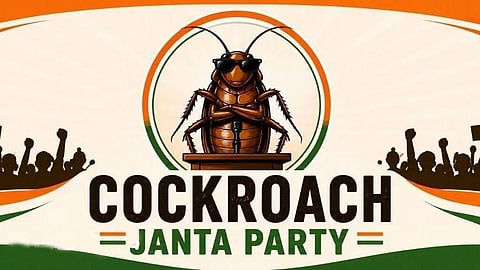
The response was immediate and characteristically digital. Abhijeet Dipke, a young Indian student based abroad, launched a satirical registration drive for what he called the “Cockroach Janta Party”. The eligibility conditions themselves were biting political theatre: applicants had to be “chronically online”, “professionally unemployed”, and capable of “ranting with consistency”. What began as a meme rapidly evolved into a viral movement. Millions followed related social media pages, online volunteers designed logos and manifestos, and a strange fusion of political parody and authentic grievance emerged. Irony became organisation.
Yet the real significance of the episode lies not in the humour but in the reaction it provoked. Sections of the establishment treated the movement not merely as satire but as a possible threat. Allegations surfaced about foreign influence, digital manipulation, and hidden political sponsorship. Some commentators linked the movement to opposition ecosystems, while others portrayed it as evidence of external attempts to destabilise Indian institutions through internet culture. The government reportedly invoked legal mechanisms associated with national security and digital sovereignty, leading to restrictions on some associated accounts and online visibility.
This transformed the matter from internet comedy into a constitutional question. Democracies have always tolerated criticism more comfortably than ridicule. Criticism engages power intellectually; satire embarrasses it publicly. Authoritarian systems fear satire because it punctures the aura of invincibility surrounding institutions. Democratic systems, however, are expected to demonstrate greater resilience. The more profound issue, therefore, was not whether the Cockroach Janta Party was politically mature or intellectually coherent — it clearly thrived on exaggeration and absurdity — but whether a democracy confident in itself should respond to satire with censorship or with engagement.
India’s constitutional tradition has long recognised the importance of dissent. From the freedom movement against colonial rule to post-independence student agitations, criticism of authority has been central to democratic evolution. Satire too possesses a distinguished place in Indian public culture. Writers, cartoonists, theatre practitioners, and filmmakers have historically used humour to question power structures. The celebrated political cartoons of R. K. Laxman often portrayed ordinary citizens as bewildered spectators of elite politics. The difference today is scale and speed. Social media collapses the distance between a joke and mobilisation. A meme can now become a movement overnight.
The controversy also exposed the growing fragility of institutional trust. Courts, governments, media organisations, universities, and even civil society increasingly operate within a climate of hyper-polarisation. Every controversy immediately becomes ideological warfare. Supporters of the judiciary argued that the chief justice’s remarks were selectively interpreted and maliciously amplified. Critics argued that the clarification issued later did not erase the original sentiment perceived by the public. Between these competing narratives stood millions of young citizens already burdened by economic insecurity and institutional fatigue.
Perhaps the most revealing aspect of the episode was the language adopted by the movement itself. Cockroaches are creatures associated with survival. They endure hostile environments, adapt rapidly, and persist despite repeated attempts at extermination. By reclaiming the insult, participants converted humiliation into symbolism. The metaphor unintentionally acquired political depth: neglected citizens presenting themselves as survivors of an unforgiving economic and bureaucratic ecosystem. Such symbolic reversals are historically powerful. Marginalised communities across the world have often reclaimed derogatory labels and transformed them into badges of solidarity.
At another level, the entire affair reflected the changing nature of political participation in the digital age. Traditional party structures depend on ideology, hierarchy, cadre networks, and organisational discipline. Digital movements operate differently. They are decentralised, emotionally driven, visually communicative, and often deliberately chaotic. Their strength lies less in coherent policy and more in narrative momentum. This makes them difficult both to control and to understand. Governments accustomed to structured opposition frequently struggle to respond to meme-based mobilisation because humour cannot easily be countered through official statements.
However, the episode also raises legitimate concerns. Internet movements can indeed become vehicles for misinformation, manipulation, and external interference. Democracies must protect themselves from coordinated destabilisation campaigns. Yet the challenge lies in maintaining proportionality. Excessive securitisation of satire risks creating the very alienation authorities seek to prevent. A confident state distinguishes between genuine threats and symbolic dissent. Overreaction often enlarges the influence of fringe phenomena by granting them martyrdom and publicity.
The Cockroach Janta Party may ultimately disappear as quickly as it appeared. Viral politics is notoriously short-lived. But the anxieties it exposed are likely to endure. Behind the memes lies a generation searching for employment, recognition, and institutional empathy. Behind the humour lies exhaustion with political rhetoric disconnected from lived realities. And behind the controversy lies a larger democratic question: can institutions listen without perceiving every irreverent voice as hostility?
In the end, the episode may be remembered less for its absurdity than for its symbolism. A single courtroom metaphor triggered a nationwide conversation because the social atmosphere was already combustible. Democracies are tested not when citizens praise institutions, but when they mock them. The measure of constitutional confidence lies in the capacity to absorb ridicule without abandoning liberty. India’s future as a democratic civilisation will depend not merely on economic growth or electoral victories but on whether its institutions can engage an impatient, digitally empowered generation with humility rather than suspicion.
The “cockroaches”, after all, were not demanding palaces. They were demanding acknowledgement.
