
- Home
- Live Blog
- Breaking News
- Top Headlines
- Cities
- NE News
- Sentinel Media
- Sports
- Education
- Jobs
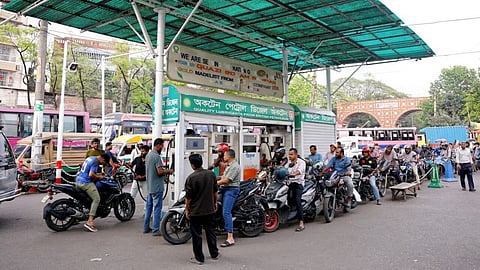
DHAKA: As fuel prices surge in Bangladesh, long queues at petrol pumps due to panic buying continue, disrupting daily life despite repeated government assurances of a stable supply, local media reported on Monday.
The government announced the price hike through a gazette notification from the Power, Energy and Mineral Resources Division on April 18, citing rising global oil market trends. Diesel prices rose by Tk 15 per litre, octane by Tk 20, petrol by Tk 19, and kerosene by Tk 18, effective Sunday night.
Reports indicate that private car owners, public transport operators, and small business owners are spending hours waiting to refuel, leading to substantial loss of time and income. Abdul Karim, a ride-sharing driver in Mirpur, said the delays have reduced his daily earnings by nearly 30 percent, as he now loses two to three hours in queues. School teacher Shahana Begum from Uttara described her own ordeal, saying she waited over one and a half hours to refuel, making daily planning stressful.
A senior Bangladesh Petroleum Corporation (BPC) official attributed the problem to short-term distribution adjustments and a surge in demand. "There is no nationwide fuel shortage, but demand has increased sharply in recent days. Some stations face supply gaps due to transport scheduling issues," the official said on condition of anonymity.
Power, Energy and Mineral Resources Minister Iqbal Hassan Mahmood Tuku described the situation as "wartime," noting that fuel must be purchased with foreign currency and that the price increase was aimed at keeping the situation manageable amid global market fluctuations.
Meanwhile, M. Shamsul Alam, energy advisor to the Consumers Association of Bangladesh, criticized the mid-month price hike as a "breach of trust," saying it undermined government credibility after assurances that prices would only change monthly.
While authorities insist there is no nationwide shortage, persistent queues highlight weaknesses in distribution and declining public confidence. Experts warn that without improved logistics, better communication, and long-term energy planning, similar disruptions are likely to recur amid global market volatility. (IANS)
Also Read: Despite big promises, Bangladesh government doing little to end mob culture: Report
