
- Home
- Live Blog
- Breaking News
- Top Headlines
- Cities
- NE News
- Sentinel Media
- Sports
- Education
- Jobs
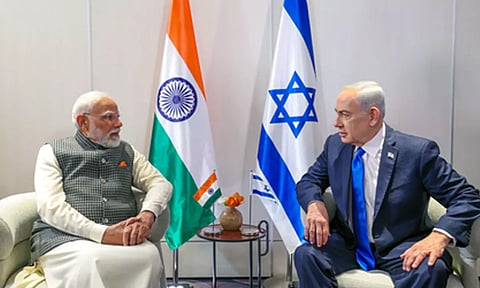
WASHINGTON: The India–Israel partnership functions primarily as an operational cooperation aimed at saving lives and dismantling terror networks. Today, both nations face similar security environments, confronting adversaries that exploit civilians, use human shields, and operate across borders, while adopting doctrines that emphasise surgical strikes, deterrence, and minimising civilian harm, a report has detailed.
Writing for US-based journal ‘The Algemeiner’, Paushali Lass, an Indian-German intercultural and geopolitical consultant, said that Israel’s recent back-to-back observance of Memorial and Independence days served as a reminder that “statehood comes at a cost, both on the battlefield and in ordinary moments shattered by terror.”
She highlighted that a year ago in Pahalgam, India faced the same reality again when Pakistan-based terrorists infiltrated Indian territory and brutally killed 26 men in front of their wives and children.
“It was not an isolated act of violence, but a deliberate strike on civilians, designed to fracture trust and deepen fear,” Lass stated.
India’s response through Operation Sindoor, she said, marked a major shift, including the suspension of key aspects of the Indus Waters Treaty following the Pahalgam terror attacks.
Lass emphasised that although India and Israel face similar threats and respond in comparable ways, global reactions vary sharply, with Israel facing sustained criticism over the “Palestinian” issue, while India’s actions against Pakistan-based terrorism have received relatively less sustained outrage.
Lass stated that India has managed the information domain effectively by presenting Operation Sindoor’s success through strategic outcomes rather than sensationalism, while also exposing Pakistan-based disinformation networks and building public resilience through media literacy initiatives to counter fake news.
“This is where Israel may need to look next. Intelligence and defence technology are no longer enough if they are not accompanied by clarity in communication,” she stressed.
Asserting that both India and Israel understand terrorism cannot be fought alone, Lass further said, “Greater intelligence sharing with allies in Europe and the United States, and a unified approach to countering terrorism — both physically and in the information domain — will be essential.” (IANS)
Also Read: Hamas should be designated as terrorist organization by India: Israel Foreign Minister
