
- Home
- Live Blog
- Breaking News
- Top Headlines
- Cities
- NE News
- Sentinel Media
- Sports
- Education
- Jobs
Kathmandu: Nepal on Sunday observed the 304th National Unification Day, coinciding with the birth anniversary of nation-builder Prithvi Narayan Shah, with leaders calling for renewed national unity in the post–Gen-Z revolution era. The day commemorates Shah’s historic role in unifying the country and preserving its sovereignty.
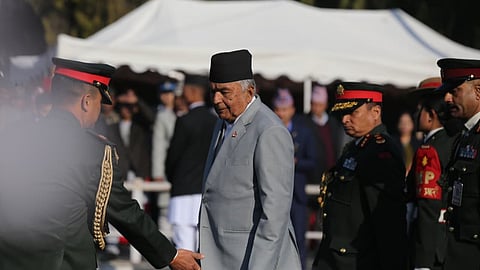
Early in the morning, President Ram Chandra Paudel, accompanied by Vice President Ram Sahaya Prasad Yadav, Prime Minister Sushila Karki, and members of the Council of Ministers, laid wreaths at the statue of Prithvi Narayan Shah in front of Singha Durbar. Similar tributes were paid across the country.
In a message on Prithvi Jayanti and National Unity Day, President Paudel highlighted Shah’s pivotal role in consolidating scattered principalities into a modern Nepal. “Remembering Prithvi Narayan Shah, we see how he unified Nepal, established national independence, and shaped a common identity. His teachings remain relevant and inspiring today,” he said.
The President noted that Shah’s ideals continue to guide Nepal in strengthening the economy, fostering patriotism, maintaining balanced diplomatic relations, preserving culture and religion, promoting public welfare, ensuring justice and good governance, and safeguarding national unity. Reaffirming Nepal’s constitutional identity, Paudel described the country as an independent, indivisible, sovereign, secular, inclusive, democratic, socialist-oriented federal republic.
“I hope National Unity Day inspires all Nepalis to uphold the nation’s independence, sovereignty, territorial integrity, and unity while working for the happiness and prosperity of the people,” he added.
The Nepali Army marked the occasion by laying wreaths at the full-length statue of Prithvi Narayan Shah at Army Headquarters and other military installations, continuing its annual tradition.
Born in 1779 BS (Bikram Sambat), Prithvi Narayan Shah ascended the throne of Gorkha at the age of 20 and launched a unification campaign despite immense social, economic, and geographical challenges. He conquered Nuwakot in 1744 and the Kathmandu Valley in 1769, later annexing eastern principalities. He passed away in 1831 BS at the age of 52.
Meanwhile, former King Gyanendra Shah, in a video address, expressed deep concern over Nepal’s future, warning that the country now faces an existential crisis. He said political, economic, and social instability over the past two decades has raised fears about the nation’s survival, reigniting debate over Nepal’s political direction. (ANI)
Also Read: Curfew imposed in Nepal’s border city Birgunj to prevent religious strife
