
- Home
- Live Blog
- Breaking News
- Top Headlines
- Cities
- NE News
- Sentinel Media
- Sports
- Education
- Jobs
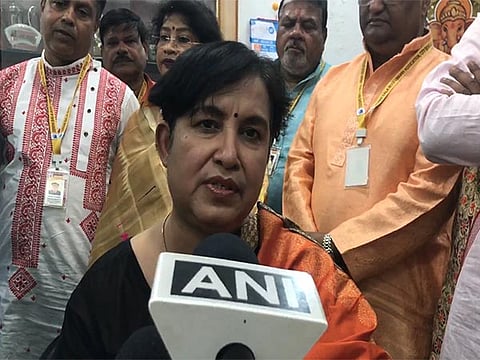
Dhaka: Bangladeshi author and activist Taslima Nasreen on Friday welcomed the defeat of Jamaat-e-Islami in Bangladesh's latest parliamentary elections, describing the outcome as a setback for extremist politics and a momentary relief for secularism, minorities, and women's rights. Reacting to the results in a post on X, she clarified that her response was not driven by enthusiasm over the victory of the Bangladesh Nationalist Party (BNP), but rather by what she termed the rejection of Islamist and jihadi forces by voters.
Nasreen argued that the electoral defeat of Bangladesh Jamaat-e-Islami represents more than a routine political shift. According to her, it signals public resistance to what she described as a pattern of extremist dominance, mob violence, and systemic intimidation over the past year and a half. She accused the party and its supporters of targeting minority Hindu communities, attacking homes, and fostering a climate of fear. She also alleged that women were excluded from political participation and subjected to misogynistic rhetoric and social restrictions.
In her statement, Nasreen claimed that Jamaat leaders opposed women's leadership, demeaned working women, and promoted strict interpretations of Sharia law. She criticized what she called the forced imposition of veils such as the burqa and niqab, and described the party as fundamentally hostile to gender equality. "I am not happy because the BNP won," she wrote, "but because the Islamists-jihadi-terrorist group was defeated." For her, the immediate positive takeaway is that Jamaat-e-Islami will not form the government.
Beyond her reaction to the results, Nasreen outlined a detailed 15-point reform agenda that she believes the new BNP-led government should adopt. Central to her proposals is the restoration of secularism in the Constitution and the removal of Islam as the state religion. She called for revoking the July 1 charter and introducing structural reforms to reduce the role of religion in governance.
Among her recommendations were the abolition of religion-based family laws and the enactment of a Uniform Civil Code to ensure equal rights for women. She also emphasized the need to safeguard freedom of speech, protect minority communities - including Hindus, Buddhists, Christians, and Indigenous peoples - and guarantee women's safety in public and political life. Educational reform featured prominently in her proposals, with a call to phase out madrasa-based religious instruction in favor of a secular, science-based system, alongside universal access to education and healthcare.
Nasreen further urged the lifting of the ban on the Awami League, arguing that democracy requires political pluralism. She said its leaders should be allowed to return from exile and participate in politics. Referring to former Prime Minister Sheikh Hasina's tenure, she noted that bloggers and free thinkers had faced violence, forcing many into exile, and insisted that safe conditions must be created for their return. She also called for rebuilding Liberation War memorials, reconstructing the historic Dhanmondi 32 residence, and re-arresting militants allegedly released from prison. Additionally, Nasreen stressed the importance of improving bilateral ties with India and advocated for the release of individuals she described as unjustly imprisoned.
According to the Election Commission, results for 297 constituencies in the 13th National Parliament election have been officially declared, marking a significant moment in Bangladesh's evolving political landscape. (ANI)
Also Read: Taslima Nasreen Criticizes Yunus' US Economic Independence
