
- Home
- Live Blog
- Breaking News
- Top Headlines
- Cities
- NE News
- Sentinel Media
- Sports
- Education
- Jobs
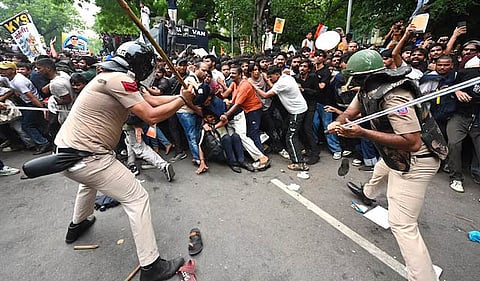
New Delhi: The Delhi High Court on Friday postponed till July 27 the hearing on a Public Interest Litigation (PIL) alleging continuous police surveillance of student protesters at Jantar Mantar. The Centre defended videography of protests, saying it is a routine law-and-order measure and that people at public demonstrations cannot expect complete privacy.
A Bench of Chief Justice Devendra Kumar Upadhyaya and Justice Tejas Karia said it would continue hearing the matter on Monday after listening to detailed arguments on the right to privacy during public protests.
Solicitor General Tushar Mehta argued that police videography of protests follows standing orders issued under Supreme Court directions and is a standard practice at major demonstrations. He said protest organisers also agree to follow these rules.
Mehta submitted that while privacy is a fundamental right, it is not absolute and can be limited when the State has a legitimate interest, such as maintaining law and order. He said video recordings help identify people responsible if violence or other incidents occur.
He also argued that protesters voluntarily record videos, give interviews and share content on social media, making claims of privacy in a public protest difficult. “There can be no expectation of privacy in a public protest unless there is intrusion into a person’s private life,” he said.
Senior advocate Nandita Rao, appearing for the petitioner, cited the Supreme Court’s K.S. Puttaswamy judgment, arguing that the right to privacy also applies to people protesting in public. She said any restriction on privacy must meet constitutional tests of legality, necessity and proportionality.
Rao alleged that plainclothes police personnel were filming protesters, including female students, and referred to reports claiming AI-powered facial recognition technology was being used. She warned that such surveillance without legal safeguards could wrongly target innocent people and discourage democratic dissent.
The Bench observed that similar petitions on the issue are already pending before the High Court and suggested the petitioner join those proceedings. However, Rao argued this case is different as it specifically challenges continuous surveillance before the July 20 police action.
The PIL, filed by former JNUSU president Aishe Ghosh, claims constant photography, videography and surveillance at Jantar Mantar have become tools of intimidation. It seeks a legal framework governing police surveillance, data protection and the use of facial recognition technology. (IANS)
Also Read: ‘Agitation will continue’...CJP writes to Sonam Wangchuk to end hunger strike
