
- Home
- Live Blog
- Breaking News
- Top Headlines
- Cities
- NE News
- Sentinel Media
- Sports
- Education
- Jobs
New Delhi: Congress's opposition to a key enabling amendment has triggered a political storm over women's reservation, with analysts arguing it has pushed what could have been an immediate reform into the distant future.
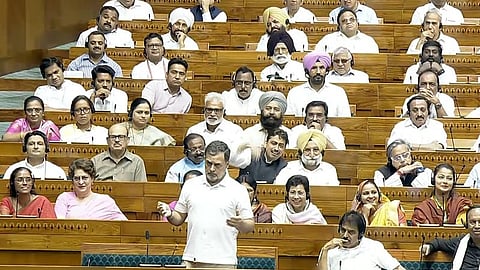
The controversy has intensified after a crucial constitutional amendment failed in the Lok Sabha, with several political observers slamming the opposition-especially the Congress-for what they describe as derailing the possibility of immediate implementation.
Analysts have underlined what they call a growing wave of misinformation in public discourse. They argue that sections of the media and political voices have added to the confusion. Analysts accuse Congress MP Priyanka Gandhi of repeating claims that do not align with constitutional provisions.
At the heart of the entire debate and political slugfest is the collapse of the Constitution (131st Amendment) Bill, which aimed to reserve 33 per cent of seats for women in the Lok Sabha and state assemblies.
After a heated debate that stretched past midnight on Friday, the Bill failed to secure the required two-thirds majority, receiving 298 votes in favour and 230 against. The outcome is being seen by many observers as a major setback that has delayed the rollout of women's reservation. The dispute has also brought renewed focus on what the law actually allows. The fact of the matter is that under Article 334A, reservation can only be implemented after a fresh Census is conducted following notification of the law, and after a delimitation exercise redraws constituency boundaries.
Without completing these steps, implementation in the current 543-seat Lok Sabha is not possible, making any immediate rollout unlikely.
In fact, the political flashpoint was about enabling an amendment proposed by the government led by Prime Minister Narendra Modi. This proposal sought to do away with the requirement of a post-notification Census. This way, reservations could have been implemented sooner. However, the provision was opposed and ultimately blocked by Congress and its allies. (IANS)
Also Read: It was BJP’s event management which flopped: Congress on defeat of Women’s Reservation Bill
