
- Home
- Live Blog
- Breaking News
- Top Headlines
- Cities
- NE News
- Sentinel Media
- Sports
- Education
- Jobs
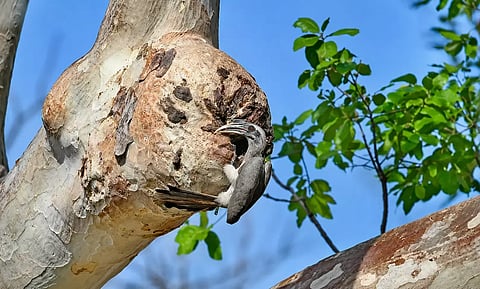
AHMEDABAD: The Indian Grey Hornbill, locally known as the Chilotro, has successfully returned to Gujarat's Gir forests after being absent for nearly six decades. A new scientific study confirms that the birds have settled, nested and begun breeding in the wild following a state-led reintroduction programme.
Published in the international peer-reviewed journal Birds, the study is the first comprehensive assessment of the project, which began in 2021 after scientific assessments found Gir's habitat suitable for the species once again.
A total of 40 Indian Grey Hornbills were translocated from the Aravalli forests and released in two phases—28 birds in 2021-22 and 12 more in 2023. Researchers found that one breeding pair nested successfully in the first year after release, while three additional pairs established nests in the second year, indicating that the programme has achieved its primary conservation objective. Satellite tracking of 11 male hornbills showed that the birds initially explored large areas before settling into smaller home ranges. Their average range shrank from about 61 sq km to 5.7 sq km, while average daily movement declined from 4.3 km to 1.4 km, reflecting successful adaptation to the Gir ecosystem.
The hornbill had disappeared from Gir during the 1950s and 1960s. Researchers attribute its successful return to improved habitat protection following the declaration of the Gir Wildlife Sanctuary in 1965 and Gir National Park in 1975. The study also highlights the species' ecological importance as an effective seed disperser, contributing to the natural regeneration of fruit-bearing trees and forest ecosystems. The reintroduction is part of broader wildlife conservation efforts in India aimed at restoring locally extinct species to suitable habitats through scientific monitoring. (IANS)
Also Read: Rare Great Indian Hornbill Flock Spotted in Arunachal’s Village
