
- Home
- Live Blog
- Breaking News
- Top Headlines
- Cities
- NE News
- Sentinel Media
- Sports
- Education
- Jobs
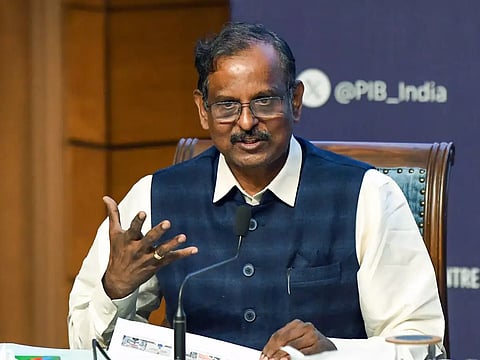
Bengaluru: India is developing technology that could enable future lunar landers to survive on the Moon for up to 200 days, a significant advancement from the 14 day operational lifespan achieved by the Chandrayaan 3 mission, ISRO Chairman V. Narayanan said.
Speaking about the ongoing research in Bengaluru on Saturday, Narayanan said the Indian Space Research Organisation (ISRO), in collaboration with the Department of Atomic Energy (DAE), was working to overcome one of the biggest challenges in lunar exploration — surviving the harsh and prolonged lunar night.
Narayanan said the effort was focused on developing advanced artificial heating systems capable of protecting spacecraft components during the extremely low temperatures experienced on the Moon after sunset.
On August 23, 2023, India created history by becoming the first country to successfully land a spacecraft near the Moon’s south pole through the Chandrayaan 3 mission. However, the Vikram lander remained operational for only one lunar day, or about 14 Earth days, as it relied on solar energy to generate power.
Once the lunar night began, the absence of sunlight and temperatures plunging to extremely low levels made it impossible for the spacecraft’s electronic systems to continue functioning.
Narayanan said ISRO and the Department of Atomic Energy were working on artificial heaters, and if successful, future landers could survive for 100 to 200 days instead of only 14 days. (IANS)
Also Read: V Narayanan Appointed New ISRO Chairman and Secretary of Department of Space
