
- Home
- Live Blog
- Breaking News
- Top Headlines
- Cities
- NE News
- Sentinel Media
- Sports
- Education
- Jobs
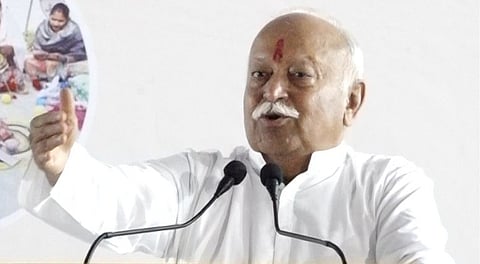
NAGPUR: Rashtriya Swayamsevak Sangh (RSS) Chief Mohan Bhagwat on Thursday delivered a pointed message on environmental stewardship and sustainable development, asserting that humanity must impose self-restraints to protect biodiversity rather than acting as the "masters of nature".
Speaking in the presence of Maharashtra Chief Minister Devendra Fadnavis and Union Minister Nitin Gadkari in Ramtek of Nagpur district, Bhagwat urged policymakers and society to draw upon India's traditional knowledge systems to build a self-reliant, ecologically balanced model of progress.
The RSS Chief was addressing a gathering at the unveiling of a memorial for veteran public leader, the late Datta Meghe, in Ramtek.
The event-which also marked the inauguration of the Nandkishor Jaiswal Agricultural College and the Shalinitai Datta Meghe Veterinary Hospital- was attended by state Ministers Chandrashekhar Bawankule, Ashish Jaiswal, and Pankaj Bhoyar.
In remarks widely seen as a subtle caution to the state government regarding unchecked development, Bhagwat emphasised the interdependence of all life forms.
"We used to believe that we are the masters of nature. However, we are a part of this universe along with nature, which makes us dependent on it and interdependent on one another," the RSS Chief said.
"Humans will be happy only when biodiversity and ecology thrive, and for that to happen, humans must impose certain restrictions on themselves. We are not the owners of nature, but a part of it."
Reflecting on his own academic background as a veterinary doctor, Bhagwat noted the shifting perception of the profession, saying that veterinary students today have access to modern facilities and no longer hesitate to state their calling. Connecting animal welfare directly to human survival, the RSS Chief highlighted the global emergence of the 'One Health' framework - an approach he maintained has been embedded in Indian culture for centuries.
"Everyone experiences the fact that if the environment is not healthy, we cannot stay healthy. If the health of animals deteriorates, it not only affects income, but their diseases are also transmitted to humans," Bhagwat warned.
"The world today is learning this through trial and error, whereas our ancestors built our way of life through hard-earned experiences."Citing the recently concluded Diwali festivities-which begin with 'Vasubaras' (dedicated to cattle) and include crafting Govardhan from cow dung- Bhagwat remarked that practices once mocked globally are now gaining scientific validation and acceptance. (IANS)
