
- Home
- Live Blog
- Breaking News
- Top Headlines
- Cities
- NE News
- Sentinel Media
- Sports
- Education
- Jobs
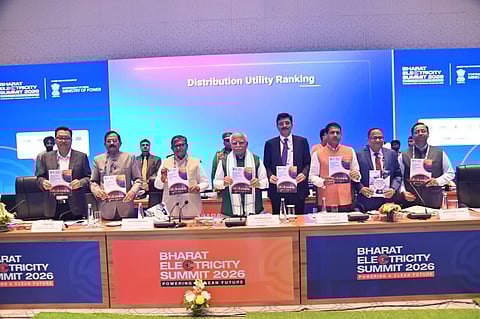
Arunachal Pradesh Deputy Chief Minister Chowna Mein placed the state's clean energy ambitions firmly on the national stage on Friday, speaking at the Power Ministerial Meet (National) and a ministerial panel discussion at the Bharat Electricity Summit 2026 in New Delhi.
The high-level meeting, held at the Yashobhoomi Convention Centre, was chaired by Union Minister for Power and Housing Affairs Manohar Lal Khattar.
Also Read: Arunachal Man Held for Allegedly Threatening Assam CM via WhatsApp
The numbers Mein put on the table are striking. Arunachal Pradesh holds a hydropower potential of 58,000 MW — more than 38% of India's entire national hydropower capacity.
Despite this, a large portion of that potential remains untapped, held back by infrastructure gaps, transmission bottlenecks, and the high costs associated with developing projects in difficult Himalayan terrain.
Mein framed unlocking this potential not just as a state priority, but as a critical contribution to India's broader clean energy transition.
During the panel discussion — held alongside Union Minister of State for Power Shripad Naik and Goa Power Minister RM Dhavalikar — Mein outlined a clear set of asks from the Centre.
He called for the fast-tracking of viable hydropower projects through Central Public Sector Undertakings (CPSUs) as a way to mitigate the rising project costs that have slowed development.
On infrastructure, the Deputy CM stressed the urgent need to upgrade both intra-state and inter-state transmission capacity, proposing the development of 220 kV and higher voltage networks to meet future power demand. He also advocated for synchronised planning to ensure coordinated power evacuation across river basins — a technical necessity given the scale of projects spread across multiple watersheds.
One of Mein's most specific policy requests was the extension of the Inter-State Transmission System (ISTS) charge waiver beyond its current deadline of June 2028 — all the way to 2035.
The waiver, which reduces the cost of transmitting power across state lines, is seen as essential for keeping hydropower tariffs competitive and attracting investment to the sector.
He also called for strengthening the roads, bridges, and enabling civil infrastructure needed to support project implementation in the state's remote and challenging terrain.
The ministerial deliberations at the Bharat Electricity Summit 2026 covered a wide range of sector-wide issues, including the financial health of power distribution companies (DISCOMs), the proposed Electricity Amendment Bill, the National Electricity Policy, and India's ambitious roadmap for achieving 100 GW of nuclear capacity by 2047.
Arunachal Pradesh's pitch for hydropower investment sits squarely within this national conversation — as India races to diversify its energy mix and meet its long-term clean power targets.
