
- Home
- Live Blog
- Breaking News
- Top Headlines
- Cities
- NE News
- Sentinel Media
- Sports
- Education
- Jobs
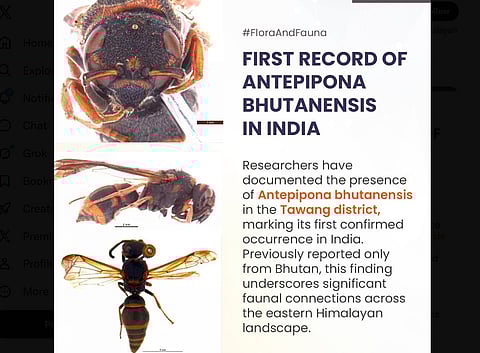
Arunachal Pradesh has added a significant entry to India's biodiversity record, with the first confirmed presence of Antepipona Bhutanensis — a species of potter wasp previously known only from Bhutan — discovered in the Tawang district.
Deputy Chief Minister Chowna Mein shared the development on X on Friday, describing it as a notable milestone in the documentation of the state's faunal diversity.
"Researchers have recorded Antepipona Bhutanensis in the Tawang district, marking its first confirmed presence in India," Mein said.
He noted that the species was "earlier known only from Bhutan," and emphasized that "the finding highlights faunal linkages across the eastern Himalayan region" — a biodiversity hotspot spanning parts of India, Bhutan, Nepal, and Myanmar.
Mein extended his appreciation to the research team for their work in documenting the region's natural heritage.
Also Read: Pema Khandu Highlights ₹400 Cr Sports Projects in Arunachal
Antepipona Bhutanensis belongs to a group of solitary wasps commonly known as potter wasps, named for their distinctive habit of constructing mud nests.
Beyond their interesting nesting behaviour, these insects play an important ecological role as natural pest controllers, helping maintain balance within ecosystems.
The finding carries significance beyond taxonomy. Experts note that such discoveries are crucial for conservation planning, particularly in regions facing increasing environmental pressure.
The documentation of this species in Tawang adds to a growing body of evidence that the eastern Himalayan landscape supports interconnected wildlife populations that cross political boundaries — strengthening the case for coordinated transboundary conservation efforts across the region.
The discovery further reinforces Arunachal Pradesh's standing as one of India's most biodiversity-rich frontiers, where ongoing research continues to yield new species records and deepen scientific understanding of the fragile Himalayan ecosystem.
