
- Home
- Live Blog
- Breaking News
- Top Headlines
- Cities
- NE News
- Sentinel Media
- Sports
- Education
- Jobs
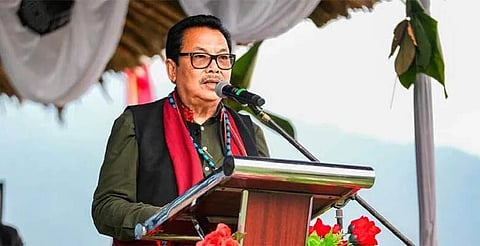
Arunachal Pradesh Deputy Chief Minister Chowna Mein launched a sharp attack on the opposition on Monday over the failure of the women's reservation legislation in Parliament, accusing it of once again standing in the way of giving women their rightful place in governance.
In a series of posts on X, Mein framed the debate in stark terms: "Appeasement vs Empowerment: The difference is clear!"
Mein drew a pointed contrast between what he described as the Congress party's historical approach to women and the current government's record.
He alleged that Congress politics had always revolved around projecting women as helpless, while the Modi government had worked toward building a foundation for a strong and empowered woman.
He also noted a generational shift in public thinking, saying the arguments and questions being raised by today's youth showed that slogans alone no longer sufficed — people were looking for results.
Taking a dig at the opposition more broadly, he said it was understandable that they felt rattled seeing bills that had gathered dust for decades finally being pursued as actionable legislation.
Also Read: Women’s Reservation Bill will transform India’s political governance landscape: Pema Khandu
Mein turned his attention specifically to West Bengal, targeting Chief Minister Mamata Banerjee for what he described as indecision and silence on issues concerning women's safety.
He characterised the West Bengal government as one defined by empty promises and administrative failure, and said that a system opposing the rights of Nari Shakti had now been judged by the people.
Mein also used the occasion to lay out the specifics of the reservation framework as he understood it — pushing back on concerns that the bill would disrupt existing political representation.
He said the Nari Shakti Vandan Adhiniyam proposed expanding the Lok Sabha from its current 543 seats to around 815 seats, with the additional seats used to accommodate the 33 per cent women's quota.
Under this approach, he said, no sitting MP would lose their position and no state would lose its existing share of seats — making the plan inclusive by design.
The Constitution (131st Amendment) Bill, which sought to implement 33 per cent reservation for women in the Lok Sabha and state assemblies through this expansion model, failed to secure the required two-thirds majority in Parliament.
Reiterating his position, Mein said the opposition's blocking of the bill was not an isolated stance but reflected a deeper reluctance to support structural reforms that would genuinely empower women in public life.
He asserted that the initiative was designed to strengthen Indian democracy by ensuring greater and fairer representation — and that its failure said more about those who opposed it than those who championed it.
