
- Home
- Live Blog
- Breaking News
- Top Headlines
- Cities
- NE News
- Sentinel Media
- Sports
- Education
- Jobs
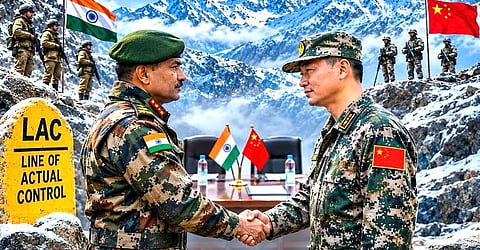
Itanagar: India and China have concluded a second round of Corps Commander-level military talks along the Arunachal Pradesh frontier today, Led by Lieutenant General Girish Kalia, the Indian delegation discussed ground-level engagement protocols and communication channels to prevent troop face-offs along the Line of Actual Control (LAC) ahead of winter.
The second round of India-China military talks in Arunachal Pradesh focused on preventing confrontations between troops deployed along the disputed frontier.
The discussions involved the People's Liberation Army (PLA) as the Chinese military counterpart, with representatives from India's Ministry of External Affairs (MEA) also participating.
The proposed arrangements include ground-level engagement protocols and communication channels intended to help both militaries manage face-offs and avoid escalation.
Lieutenant General Girish Kalia, General Officer Commanding of the Indian Army's III Corps, led the Indian delegation during the discussions.
The November round follows an earlier meeting held on September 6–7 at the Wacha-Damai Border Personnel Meeting point in Kibithoo.
The latest discussions represent the second round of eastern sector Corps Commander-level engagement, following 23 rounds of similar military-level talks in eastern Ladakh since 2020.
The discussions come against the backdrop of reported friction in the Taksing area of Upper Subansiri district since July 2026.
Former Indo-Tibetan Border Police Director-General Shatrujeet Kapur also reportedly confirmed active face-offs at multiple locations in October.
Arunachal Pradesh Chief Minister Pema Khandu had earlier commented on the border situation, highlighting the difficulty of managing an undefined boundary.
"Transgression has definitely happened. It continues to happen. Such behaviour is not new, as the border is not defined," he said.
The reported developments concern approximately 1,140 kilometres of the LAC along Arunachal Pradesh.
The immediate challenge for both militaries is implementing the agreed arrangements before peak winter conditions affect movement in the mountainous frontier areas.
Heavy snowfall could block forward mountain passes, creating logistical difficulties for personnel operating in the region.
The proposed implementation timeline is immediate, reflecting the approaching winter conditions and the need to maintain communication between deployed troops.
The effectiveness of the latest engagement will depend on how consistently both sides implement the ground-level protocols and communication arrangements.
The second round, however, marks another attempt to manage tensions through military-level dialogue along the eastern sector frontier.
