
- Home
- Live Blog
- Breaking News
- Top Headlines
- Cities
- NE News
- Sentinel Media
- Sports
- Education
- Jobs
OUR CORRESPONDENT
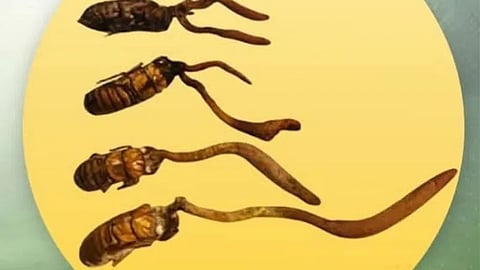
ITANAGAR: In a major scientific breakthrough, researchers from the Central Agricultural University (CAU) at Pasighat have identified the highly prized Cordyceps mushroom in Arunachal Pradesh's East Siang district, marking a rare low-altitude occurrence that has drawn significant scientific attention.
Widely known as 'Himalayan Gold', Cordyceps is regarded as one of the world's most valuable medicinal fungi due to its rich bioactive compounds such as cordycepin and adenosine, which are associated with immunity enhancement, anti-inflammatory properties, metabolic health support, and cancer research.
According to officials at the CAU, the discovery is scientifically significant as Cordyceps species are generally found in alpine Himalayan regions at elevations above 3,000 to 4,500 metres.
Reports and scientific studies from the Himalayan belt of Sikkim, Uttarakhand, Nepal, and Tibet have consistently documented the fungus in high-altitude meadows and cold desert ecosystems, making its occurrence in a relatively lower-altitude zone of East Siang highly unusual.
The discovery is expected to open new avenues for mycological research, biodiversity conservation, sustainable cultivation, and livelihood generation in Northeast India, officials said.
Cordyceps, scientifically known as Ophiocordyceps sinensis, is a parasitic fungus that grows on insect larvae and has been used for centuries in traditional Tibetan and Chinese medicine.
Due to its rarity and medicinal demand, it commands extremely high prices in international herbal markets and has often been described as 'Himalayan Viagra' in popular literature.
Studies have shown that the fungus plays a significant role in the rural economy of several Himalayan communities, although overharvesting and climate change have raised concerns over its sustainability and conservation.
Meanwhile, state Deputy Chief Minister Chowna Mein, in a social media post, termed the finding a 'major scientific breakthrough' for the state and highlighted its potential to strengthen research, conservation, and the emerging bioeconomy sector of the Northeast.
He observed that the discovery reflects the immense and largely untapped biodiversity wealth of Arunachal Pradesh and could pave the way for future scientific exploration and sustainable economic opportunities for local communities.
Officials said the finding has further reinforced Arunachal Pradesh's reputation as one of India's richest biodiversity hotspots, with scientists increasingly documenting rare flora and fauna from the ecologically sensitive Eastern Himalayan region.
Also Read: Two dragonfly species discovered in Siang Valley of Arunachal Pradesh
