
- Home
- Live Blog
- Breaking News
- Top Headlines
- Cities
- NE News
- Sentinel Media
- Sports
- Education
- Jobs
OUR CORRESPONDENT
SIVASAGAR: The devastating floods that ravaged Sivasagar district between July 18 and 26 have affected more than four lakh people, making it one of the worst flood disasters in the district's recent history. According to the latest cumulative flood assessment released by the district administration, a total of 4,03,134 people across 385 villages have been impacted.
The floods have claimed 31 lives, while three persons remain missing, highlighting the magnitude of the disaster. Rescue and relief operations are continuing on a war footing, with the district administration, government departments, disaster response agencies, and volunteers working in close coordination to assist affected residents.
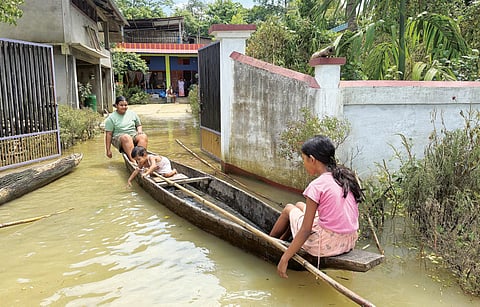
A total of 20,520 people have been evacuated from vulnerable areas and shifted to relief camps and safer locations. To support rescue operations, 121 boats have been deployed across the district, while 43 medical teams have been pressed into service to provide healthcare and prevent the outbreak of water-borne diseases. In addition, five helicopter sorties have been carried out for aerial reconnaissance, emergency relief distribution, and other critical operations.
The floods have caused extensive damage to agriculture, with nearly 28,000 hectares of cropland submerged. Livestock has also suffered heavily, with 66,044 large animals and 75,234 small animals, including cattle, goats, and poultry, reported affected.
Public infrastructure has sustained significant damage. A total of 215 roads, spanning 158.56 kilometres, have been damaged, disrupting connectivity across the district. Around 350 schools have suffered partial or complete damage, while 101 power installations, including electric poles, transformers and transmission lines, have been affected, hampering electricity supply in several areas.
Drinking water infrastructure has also been severely impacted, with 462 Public Water Supply Schemes (PWSS) affected. Furthermore, 19 embankments, covering 12.36 kilometres, have been damaged, raising concerns over flood protection and future vulnerabilities. The floods have also affected several public institutions, including 36 Anganwadi Centres, four ICDS projects, one community hall, nine fishery centres, and 13 AYUSH centres.
District Commissioner Mridul Yadav has been personally monitoring relief operations in flood-affected areas, overseeing the distribution of essential relief materials and interacting with affected families to assess their immediate requirements.
The district commissioner informed that medical camps are operating in flood-hit areas, providing treatment and essential medicines to affected residents. He added that fodder is being distributed to safeguard livestock, while the distribution of the Chief Minister's Special Relief Kits among affected families is progressing steadily.
Also Read: Assam: Central inter-ministerial team reviews flood situation in Sivasagar
