
- Home
- Live Blog
- Breaking News
- Top Headlines
- Cities
- NE News
- Sentinel Media
- Sports
- Education
- Jobs
A CORRESPONDENT
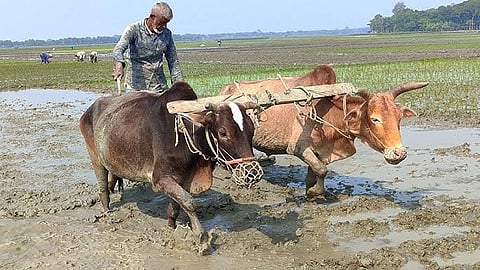
NALBARI: The traditional practice of ploughing fields with bullocks and buffaloes is now rarely seen in Assam's villages. Only a handful of farmers still cultivate their land using animal-drawn ploughs. In earlier times, almost every farmer in rural areas depended on bullocks or buffaloes for tilling their fields.
Today, tractors, power tillers, and other modern agricultural machines have largely replaced animal-powered ploughing. Even during the threshing season, farmers now use mechanical threshers instead of relying on cattle. Notably, while a farmer using traditional bullock ploughs could earlier cultivate only about two bighas of land, the same farmer can now cultivate more than twenty bighas with the help of machinery. There is no denying that mechanisation has significantly increased agricultural productivity and profitability. However, this transition has also led to the gradual disappearance of the age-old tradition of ploughing with bullocks and buffaloes. Consequently, the number of cattle owned by farming families has steadily declined.
Scenes of farmers joyfully singing folk songs while ploughing their fields, enjoying traditional breakfasts of soft rice in the fields during breaks, women transplanting paddy seedlings, singing melodious tunes, and farmers toiling under the sun have now become part of history.
Machines have made farming easier, reduced physical labour, and increased productivity. Yet many elderly farmers believe this convenience has come at a cost.
Veteran farmer Horo Rajbanshi observes, "Yes, we work less and harvest more today. But farmers like us have become more prone to illness. In the past, we worked hard both at home and in the fields, and diseases rarely affected us. Now that physical labour has reduced, health problems have increased."
He recalls that every household once had cows along with bullocks, and cowsheds were full of livestock. The abundance of cattle ensured a steady supply of organic manure, allowing farmers to cultivate crops without depending heavily on chemical fertilisers and still achieve excellent yields.
However, whether due to mechanisation or the rapid pace of modernisation, farmers have gradually moved away from rearing cattle. Adding to the problem, frequent incidents of cattle theft in rural areas have discouraged livestock farming even further. As a result, mechanised farming has become the dominant method of agricultural production in Assam, while the traditional sight of bullock and buffalo ploughs is slowly disappearing from both agriculture and rural life.
Also Read: Night Theft of Bullocks Leaves Kamargaon Farmer Helpless Ahead of Paddy Season
