
- Home
- Live Blog
- Breaking News
- Top Headlines
- Cities
- NE News
- Sentinel Media
- Sports
- Education
- Jobs
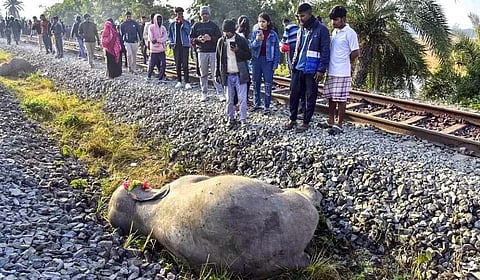
Lakhimpur: A 12-to-14-year-old male elephant died at 2:30 pm on Thursday, November 26, after a locomotive struck and dragged it while it crossed railway tracks in Dulong Reserve Forest, Assam’s Lakhimpur district on Wednesday night.
The collision occurred near Rupahi–Rajgarh between 8:05 pm and 8:10 pm as the animal crossed with another elephant in search of food.
The collision occurred inside Dulong Reserve Forest under Pathalipam Forest Beat in the Rupahi–Rajgarh area of Lakhimpur district.
The locomotive was travelling from Gogamukh towards Bogeenadi when it struck one of two elephants crossing the railway tracks in search of food.
The impact dragged the elephant for up to 100 metres before throwing it approximately 50 metres away from the tracks.
Pathalipam Forest Beat personnel from the Assam Forest Department were among the first responders following the incident. Despite the response to the incident, the injured elephant died at approximately 2:30 pm on Thursday.
A specialised veterinary team from the Tinsukia-based Wildlife Trust of India (WTI) was involved in the response.
The elephant was estimated to be between 12 and 14 years old and was male.
Local wildlife conservationist Pradeep Gogoi said Dulong Reserve Forest serves as a vital elephant corridor, supporting a population of more than 600 elephants.
Gogoi criticised railway authorities for what he described as a lack of sensitivity towards wildlife safety and inadequate district-level emergency preparedness.
The latest death has renewed concerns about the risks elephants face while crossing railway tracks through the forest. The latest fatality adds to a record of train-related elephant deaths in the area.
Four elephant deaths linked to train collisions were recorded locally between 2021 and 2024.
Despite existing speed restrictions and a joint Forest Department–Northeast Frontier Railway (NFR) WhatsApp alert group, fatal collisions have still continued.
The recurrence of such incidents has raised questions about the effectiveness of existing railway safety arrangements in elephant movement zones.
The latest incident has renewed demands for relocating railway tracks away from sensitive elephant movement areas.
Conservation concerns have also prompted calls for a dedicated wildlife rescue unit to improve emergency response when elephants are injured in railway accidents.
The Assam Forest Department and Northeast Frontier Railway are the key agencies involved in the existing response and railway safety arrangements.
The death in Dulong Reserve Forest has once again drawn attention to the continuing conflict between railway operations and elephant movement through forest corridors.
