
- Home
- Live Blog
- Breaking News
- Top Headlines
- Cities
- NE News
- Sentinel Media
- Sports
- Education
- Jobs
OUR CORRESPONDENT
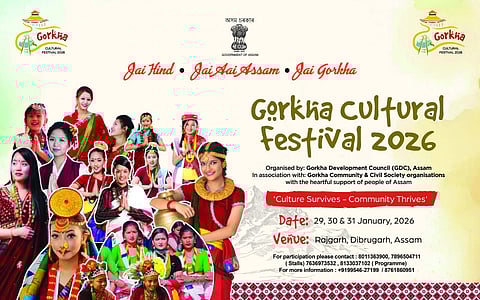
DIGBOI: The Gorkha Mahotsav 2026, scheduled from January 29 to January 31 at Rajgarh near Khowang in Assam’s Dibrugarh district, is fast emerging as more than a cultural celebration, carrying clear political and electoral significance in the run-up to the state’s evolving political discourse.
Organized by the Gorkha Development Council (GDC), Government of Assam, the three-day festival is being positioned as a major assertion of Gorkha identity, unity, and visibility in Upper Assam, where the community constitutes a decisive socio-political presence.
The Mahotsav will showcase traditional Gorkha music, dance, folk art, ethnic cuisine, and cultural exhibitions, with participation expected from cultural troupes across the state. Organizers say that the event is designed to highlight not only cultural heritage but also the aspirations of a community seeking sustained political recognition and development. The choice of Dibrugarh, an important political and economic hub of Upper Assam, adds to the festival’s strategic importance.
Speaking to The Sentinel while briefing on the various agendas of the event, Prem Tamang, Chairman of the Gorkha Development Council, underlined that the Mahotsav reflected a broader vision that went beyond celebration. He said that the programmes were aimed at consolidating community unity, empowering youth, and reinforcing the Gorkhas’ rightful place in Assam’s socio-political landscape.
Tamang disclosed that Chief Minister Dr Himanta Biswa Sarma was likely to grace the occasion, a development that triggered palpable excitement across Gorkha-dominated regions of the state. “All Gorkhas of Assam are waiting with excitement,” he said, describing the proposed visit as a strong signal of political acknowledgment at the highest level.
Political observers note that the Chief Minister’s possible presence at the Mahotsav assumes significance at a time when ethnic communities are increasingly seeking direct engagement and assurances from the government. The Gorkha community, spread across tea garden belts, urban centres, and border regions of Assam, has long demanded greater institutional support, cultural recognition, and development-oriented policies. The Mahotsav is thus being viewed as a platform where cultural assertion intersects with political messaging.
Prem Tamang, who has been spearheading the causes of the Gorkhas in Assam, has emerged as a key intermediary between the community and the State Government. Under his leadership, the GDC has seen enhanced budgetary support and expanded programmes focusing on education, skill development, cultural infrastructure, and welfare initiatives. The Mahotsav, he asserted, is aligned with this larger agenda of inclusive development and political empowerment.
As preparations intensify, the Gorkha Mahotsav 2026 is expected to draw widespread attention from political stakeholders, community leaders, and the media. Beyond its cultural appeal, the festival is shaping up as a significant moment of political outreach and consolidation, underscoring the growing relevance of the Gorkha electorate in Assam’s contemporary political narrative.
Also Read: Azadi Ka Amrit Mahotsav: Debate competition organized by Gorkha Rifles
