
- Home
- Live Blog
- Breaking News
- Top Headlines
- Cities
- NE News
- Sentinel Media
- Sports
- Education
- Jobs
A CORRESPONDENT
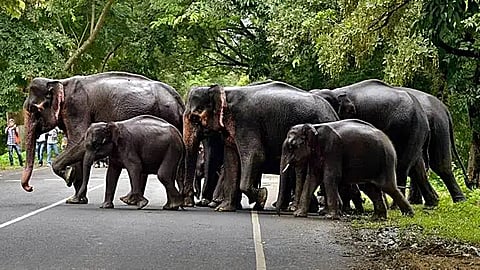
BOKAKHAT: The menace of wild elephants has taken a severe turn in the Numaligarh, Morangi, and Chinatali areas under the Golaghat Forest Division, primarily due to acute food scarcity and shrinking forest habitats. According to officials of the Golaghat Forest Division, wild elephant attacks in Golaghat district this year have resulted in the deaths of 10 people, injuries to six others, destruction of 85 houses, and damage to 169 bighas of agricultural land. Unofficial sources, however, suggest that the actual extent of damage may be significantly higher.
Records indicate that between 2010 and December 2025, human–elephant conflict in the district has led to the deaths of 83 people, destruction of 2,362 houses, and damage to 5,445.83 bighas of paddy fields. Officials and conservationists attribute the rising conflict largely to the alarming decline in forest cover across Golaghat district.
In recent years, evergreen forest landscapes in Golaghat, like many parts of Assam, have come under increasing pressure from encroachment and deforestation. These activities have intensified human–elephant conflict by severely reducing the animals’ natural habitat. Reports indicate that of the 103,796.87 hectares of forest land in the Nambar–Daigrong forest area under the Golaghat Forest Division, nearly 86,550 hectares are currently under encroachment. Even today, about 134 hectares of land in the Numaligarh Deopahar area remain encroached upon.
Large stretches of forest land have gradually been converted into human settlements, forcing wild animals—particularly elephants—to venture into villages in search of food. As a result, elephants frequently raid farmlands and occasionally attack people, as forest areas increasingly transform into inhabited zones.
Across Assam, widespread encroachment on forest land, destruction of natural vegetation, and construction activities on elephant corridors have further aggravated the problem. In several areas, villages and agricultural fields have been established directly on traditional elephant movement routes. This has left elephants deprived of both habitat and food, pushing them into closer contact with human populations.
Survey data further reveal extensive encroachment across multiple reserved forests. Of the total forest areas, nearly 18,500 hectares of the Diphu Reserved Forest (18,360 hectares); 27,240.61 hectares of Nambar South; 12,500 hectares of the Rengma forest (out of 13,921.49 hectares); 8,000 hectares of Nambar North (out of 15,420 hectares); and 23,000 hectares of Dayang forest (out of 24,637.77 hectares) are reportedly under encroachment.
Also Read: Human-elephant conflict intensifies in Rani; minor narrowly escapes death
