
- Home
- Live Blog
- Breaking News
- Top Headlines
- Cities
- NE News
- Sentinel Media
- Sports
- Education
- Jobs
A powerful storm that tore through the Rani area on the outskirts of Guwahati on the night of March 16 has left a trail of destruction across more than a dozen villages, with thousands of residents bearing the aftermath nearly a week later.
The worst-affected villages include Puran Sukurboriya, Belguri, Nalapara, Secha, Tanganpara, Thengapara, Challi, Joypur, and Garopara — all located along the Meghalaya border — as well as nearby areas such as Berigaon, Balapur, Loharghat, Kulsi, and the Borduwar Tea Estate.
Houses were damaged or blown away entirely, and trees were uprooted across a wide area, causing extensive disruption to daily life.
Also Read: Assam: Work begins at Zubeen Kshetra after damage by storm at Sonapur
The storm dealt a heavy blow to the region's electricity infrastructure, snapping transmission lines and damaging power poles at multiple locations.
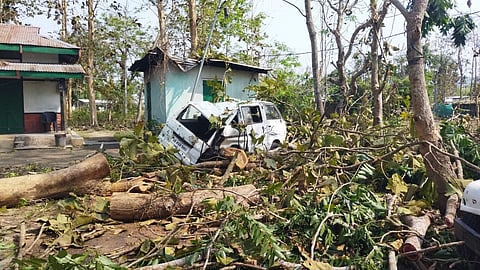
The Jarasal Reserved Forest also suffered significant damage, with numerous trees uprooted across the forest area. At the Nalapara Range Forest Office, a large teak tree fell within the premises — narrowly missing forest personnel on site. The office's only government vehicle, a Maruti car, was damaged in the incident.
Since March 17, workers from the Assam Power Distribution Company Limited (APDCL) have been engaged in round-the-clock restoration work.
Approximately 75 percent of the affected areas have had power restored within the first two days. However, Tanganpara, Garopara, and large parts of Joypur remain without electricity — leaving residents in these villages in darkness for five consecutive days.
Beyond the inconvenience of living without power, residents in the still-affected areas face a more pressing concern — safety.
The Rani region is well known for frequent wild elephant movement, and locals say the absence of electricity at night significantly increases the risk of dangerous human-elephant encounters.
Residents have urgently appealed to the power department to expedite restoration work, stressing that the darkness is not just an inconvenience but a genuine safety threat in an area where elephant incursions after dark are a known and recurring hazard.
