
- Home
- Live Blog
- Breaking News
- Top Headlines
- Cities
- NE News
- Sentinel Media
- Sports
- Education
- Jobs
A CORRESPONDENT
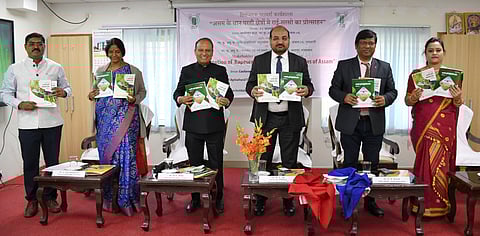
AZARA: Dr ML Jat, Secretary, Department of Agricultural Research and Education (DARE) and Director General, Indian Council of Agricultural Research (ICAR), visited the ICAR-Agricultural Technology Application Research Institute (ATARI), Zone VI, Guwahati, on Monday to review strategies for intensification of rice fallow areas in Assam.
During the visit, Dr G Kadirvel, Director, ICAR-ATARI, Guwahati, presented a comprehensive overview of the institute's achievements and ongoing initiatives. He highlighted concerted efforts to bring large tracts of rice fallow land in Assam under productive cultivation through the promotion of crops such as toria, maize, potato and lentil, and emphasized the pivotal role of Krishi Vigyan Kendras (KVKs) in technology dissemination and capacity building.
Dr Jat chaired detailed interactions under a Stakeholder Consultation Workshop on 'Promotion of Rapeseed-Mustard in Rice Fallows of Assam' and 'Promotion of Millet Technologies.' The interaction involved scientists and heads of ICAR institutes, officials of ICAR-ATARI, KVK scientists from various districts, representatives of the State Department of Agriculture, Assam Agricultural University, Farmer Producer Organizations (FPOs/FPCs), and progressive farmers.
Addressing the gathering, the Director General noted that inadequate seed availability remains a major constraint in realizing the potential of rice fallow areas. He called for strengthening farmer-participatory seed systems, promotion of seed villages, and efficient utilization of existing seed processing infrastructure. Highlighting the vast untapped potential of rice fallows, particularly for toria and mustard, he advocated a cluster-based approach to address seed supply, moisture management, mechanization, and post-harvest operations simultaneously, including the establishment of community-level dryers.
Dr Jat also suggested large-scale adoption of proven mechanization tools such as mustard planters and stressed the need to enhance public-sector hybrid seed availability, especially for maize, through innovative seed production strategies. He emphasized alignment of District and State Mustard Missions with ICAR initiatives to ensure optimal use of resources and measurable outcomes. Greater convergence among ICAR, State Departments, universities, FPOs, and farmers was underscored as essential for achieving sustainable, outcome-oriented progress.
The meeting was attended by Dr AK Nayak, Deputy Director General (Natural Resource Management), ICAR, Dr BC Deka, Vice-Chancellor, Assam Agricultural University, and Dr C Tara Satyavathi, Director, ICAR-Indian Institute of Maize Research, along with scientists and officials from ICAR institutes, Assam Agricultural University, the State Agriculture Department, senior KVK scientists, FPO members, and progressive farmers.
Also Read: Assam's Largest Solvent Processing Unit of Rice Bran & Soya Inaugurated in Biswanath
