
- Home
- Live Blog
- Breaking News
- Top Headlines
- Cities
- NE News
- Sentinel Media
- Sports
- Education
- Jobs
A CORRESPONDENT
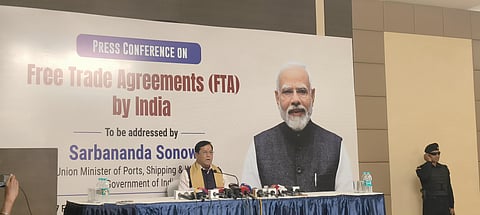
DIBRUGARH: Union Minister of Ports, Shipping & Waterways Sarbananda Sonowal on Monday said India's emergence as a major global trade power is the result of Prime Minister Narendra Modi's "nation-first leadership," contrasting it with what he described as the Congress party's record of "policy paralysis, indecision and obstruction."
Addressing a press conference in Dibrugarh, Sonowal said that since 2014 India has moved from what he termed a "defensive and hesitant trade posture" to a more confident and strategically negotiated global engagement.
He stated that nine major Free Trade Agreements (FTAs) concluded in the last six years have secured preferential access to 38 developed nations across Europe, the Gulf, Oceania and North America. These countries account for nearly 30 percent of India's export value-approximately $242 billion (around Rs 22 lakh crore). According to Sonowal, nearly 70 percent of global trade markets are now accessible to India under preferential terms through these agreements.
"For decades, Congress reduced trade policy to defensive posturing and policy paralysis. They lacked the confidence to believe that Indian industry, farmers and entrepreneurs could compete globally," Sonowal said. "Under Prime Minister Modi's leadership, India negotiates from a position of strength-expanding markets, securing better tariff terms than competing economies and safeguarding our core interests. That is the difference between narrow political thinking and nation-first leadership," he added.
Sonowal said the proposed 2026 India-US interim trade agreement symbolizes this transformation. The framework aims to increase bilateral trade to $500 billion annually and reduce reciprocal tariffs on Indian goods to 18 percent, which he said is lower than those imposed on several competing economies. Zero-duty access has been secured for key sectors such as generic pharmaceuticals, gems and diamonds, aircraft parts and select agricultural products, while preferential treatment has been extended to 232 tariff lines. He emphasized that 90-95 percent of sensitive agricultural products-including wheat, rice, maize, dairy, poultry and key spices-remain protected.
"This government has shown that global markets can be opened without compromising farmers' welfare. Congress created fear; Prime Minister Modi has created opportunity," Sonowal said.
Referring to the recently signed India-EU Free Trade Agreement, Sonowal said the deal provides preferential access to 99.5 percent of India's exports across 27 European nations, with 90.7 percent of exports by value becoming duty-free once the agreement comes into force. Labour-intensive sectors such as textiles, leather, footwear, and gems and jewellery are expected to benefit significantly, while sensitive domestic sectors remain excluded. The agreement also opens 144 services sub-sectors, strengthening India's position in IT and professional services.
Similarly, the India-UK Comprehensive Economic and Trade Agreement ensures duty-free access for nearly 99 percent of India's exports and opens 137 services sub-sectors, benefiting Indian professionals in IT, financial, telecom and education services. Agreements with Oman and New Zealand, he said, provide near-total or total duty-free access from day one, expand services market entry and create new mobility and investment opportunities.
Sonowal described these agreements as a structural shift in India's global positioning. "Prime Minister Narendra Modi has inspired confidence not only among world leaders but also among our entrepreneurs, MSMEs and youth. India will no longer be a passive participant in global trade but a rule-shaper and opportunity creator," he said.
Highlighting Assam's prospects, Sonowal said tea exports have regained zero-duty access to the US market, resulting in the strongest growth in 25 years, with shipments increasing by 40 million kg in the 2025-26 cycle. Total exports from the state are projected to exceed 150 million kg, valued at approximately Rs 2,500 crore. Sectors such as spices, specialty rice, handloom, handicrafts, bamboo products, petrochemicals and horticulture are also expected to benefit from expanded global access, with Assam's overall exports projected to cross Rs 10,000 crore by 2026-27.
"The Congress party has consistently opposed reforms, infrastructure development and transformative trade agreements because its politics thrives on pessimism. Our government has strengthened Assam's tea industry and expanded its global trade prospects through the agreement with the US," Sonowal said. "They never believed India could compete globally. Prime Minister Modi has proven them wrong by opening markets worth trillions of dollars, generating employment for youth and women, empowering MSMEs and ensuring that sensitive sectors remain protected."
"These trade agreements reflect the confidence of a New India," the Union Minister added. "Under Prime Minister Modi's leadership, India is creating value, wealth and opportunity for its people. This is the pathway to a Viksit Bharat-strong at home, respected abroad and prosperous for every citizen."
Also Read: Union Budget anchors Northeast at heart of India’s growth story: Sarbananda Sonowal
