
- Home
- Live Blog
- Breaking News
- Top Headlines
- Cities
- NE News
- Sentinel Media
- Sports
- Education
- Jobs
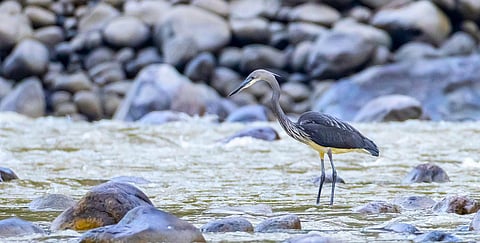
Itanagar: Researchers from the Wildlife Institute of India (WII) documented a critically endangered White-bellied Heron in Arunachal Pradesh along the banks of the Lohit River on November 12, 2026. The sighting, publicly announced on November 18, has prompted Deputy Chief Minister Chowna Mein to call for immediate habitat conservation to protect the bird's surviving population.
Reacting to the discovery, Arunachal Pradesh Deputy Chief Minister Chowna Mein highlighted the importance of protecting the state's river ecosystems.
Mein said, "The sighting of the Critically Endangered White-bellied Heron along the Lohit River, documented by the Wildlife Institute of India research team, highlights the ecological significance of our pristine river ecosystems."
His statement draws attention to the importance of conserving the natural habitats that sustain the country's critically endangered bird population.
The Wildlife Institute of India research team documented the sighting, while the Ashoka Trust for Research in Ecology and the Environment (ATREE) is among the biodiversity research organizations associated with conservation concerns surrounding the region.
The discovery highlights the ecological importance of the Lohit River basin, which supports a significant share of India's remaining White-bellied Herons.
With just six to nine individuals estimated to survive in the wild across India, conservationists face growing concerns about the future of the species.
The latest sighting is particularly significant because of the extremely small number of White-bellied Herons surviving in the wild.
Key figures underline the conservation challenge:
India's wild population: Estimated at just 6–9 individuals.
Global wild population: Fewer than 60 individuals.
Lohit basin: Accounts for approximately 70% of India's population.
Indian legal protection: Listed under Schedule I of the Wildlife (Protection) Act, 1972.
IUCN conservation status: Critically Endangered since 2007.
The White-bellied Heron is a large bird measuring approximately four feet in height. Its critically endangered classification reflects the severe threat facing its remaining wild population.
The Lohit River basin, together with the Lahm and Noa-Dihing rivers, forms one of the last strongholds for the White-bellied Heron in India.
However, conservationists have raised concerns about proposed hydropower infrastructure projects that could affect the bird's shallow riverine habitat.
One major concern is the proposed 1,200-MW Kalai-II hydropower project. Conservationists have warned that infrastructure development could threaten the river conditions on which the species depends.
The Lohit basin's importance is particularly clear given that it supports around 70% of India's remaining White-bellied Herons.
The November 12 sighting provides an important record of the species' continued presence along the Lohit River. However, with India's estimated wild population below 10, protecting the remaining habitat is a pressing conservation concern.
The call for immediate conservation from Deputy Chief Minister Chowna Mein places renewed attention on the ecological importance of Arunachal Pradesh's river systems.
As concerns surrounding proposed hydropower infrastructure continue, protecting the Lohit River basin and other remaining habitats will be crucial to the survival of the White-bellied Heron in India.
