
- Home
- Live Blog
- Breaking News
- Top Headlines
- Cities
- NE News
- Sentinel Media
- Sports
- Education
- Jobs
Gautam Sarmah
(gautamsarmah8@gmail.com)
Throughout the long history of human civilization, certain festivals have evolved far beyond the boundaries of mere religious rituals and have emerged as profound expressions of how societies understand nature, femininity, spirituality, and the universe itself. In a country like India, where religious traditions have always remained deeply interconnected with everyday social life, festivals have often served as important mediums through which the philosophical foundations of society can be understood. Within this broader context, the Ambubachi Mela held at the historic Kamakhya Temple has established itself as one of South Asia's most unique and culturally significant festivals. It represents a remarkable occasion where mythology, ancient philosophy, indigenous beliefs, ritual practices, and social realities merge in an extraordinary manner. More than simply a gathering of devotees, the festival reflects how ancient societies interpreted creation, feminine energy, natural cycles, and the fundamental sources of life. Studying Ambubachi, therefore, means not merely understanding a religious tradition but appreciating a broader civilizational consciousness that has evolved in Assam over centuries.
Among India's countless religious fairs and festivals, the Ambubachi Mela occupies a truly distinctive place. Held annually at this historic shrine, the festival is not confined to a religious congregation alone; rather, it stands as a living reflection of Northeast India's socio-cultural life, folk traditions, customary practices, and spiritual heritage. Every year, hundreds of thousands of pilgrims, devotees, ascetics, scholars, tourists, and spiritual seekers from Assam, all over India, and even other countries come to Kamakhya to take part in this big event. The festival represents a remarkable synthesis of faith, folk culture, fertility worship, Tantric traditions, cultural diversity, and social interaction. Its importance extends far beyond religion and reveals important dimensions of Assam's historical identity and collective social consciousness.
This is one of India's oldest and most revered Shakti Peethas. Situated atop Nilachal Hill, overlooking the Brahmaputra River, it is regarded as one of Hinduism's most sacred centres for goddess worship. Historical and archaeological evidence suggests that the present structure largely dates back to the Koch dynasty period, although its origins can be traced to the early mediaeval era. In the sixteenth century, King Koch and his brother rebuilt the temple after invaders had destroyed it. Its architecture, known as the Nilachal style, uniquely combines indigenous, Hindu, and Islamic influences. Unlike most Hindu temples, Kamakhya does not contain an idol of the goddess. Worship is offered instead to a natural rock fissure that remains continuously moistened by an underground spring. This sacred site is regarded as the symbolic representation of Goddess Kamakhya's yoni, which represents the creative force of life itself. Because of this practice, the temple has become a strong symbol of femininity, creativity, and fertility in Indian religious traditions. This unique way of worship is the spiritual basis of the Ambubachi festival.
The word 'Ambubachi' originates from the Sanskrit words 'ambu', meaning 'water', and 'bachi', meaning 'emergence' or 'manifestation'. Broadly understood, it signifies the fertilising power of water and nature's regeneration during the monsoon season. Celebrated during the Assamese month of Ahaar (June-July), the festival coincides with the arrival of the rains. According to popular belief, during this period Goddess Kamakhya undergoes her annual menstruation cycle. Consequently, the temple remains closed for three days, symbolizing seclusion during menstruation. On the fourth day, following ritual purification ceremonies, the temple reopens to devotees.
From an anthropological perspective, Ambubachi remains deeply connected with ancient fertility worship and agrarian culture. Long before organized religions emerged, early societies worshipped nature and fertility as the fundamental forces sustaining life. Many agricultural civilisations imagined the earth as a mother whose fertility ensured crops, prosperity, and the continuity of life. Ambubachi vividly reflects this worldview. The goddess's menstruation symbolizes the fertility of Mother Earth, while the monsoon rains signify the beginning of a new agricultural cycle, illustrating the intimate relationship between nature, agriculture, and human survival. One of the festival's most remarkable features is its positive and sacred interpretation of menstruation. In many societies, menstruation has historically been viewed as taboo or impure. At Kamakhya, however, it is not regarded as impure but revered as a symbol of creativity, fertility, and divine power. Scholars frequently regard it as one of the rare religious traditions in the world where the biological cycle of women is openly celebrated and sanctified. This perspective elevates the biological reality of womanhood to a cosmic dimension.
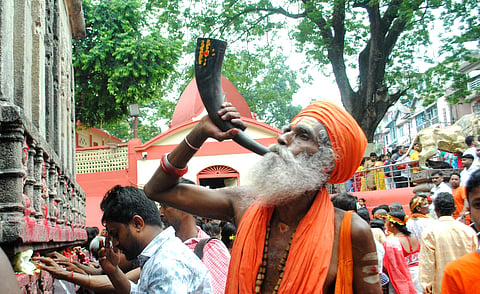
Ambubachi also shares a deep connection with India's Tantric traditions. Kamakhya has long been recognized as one of the principal centres for Tantric practices. During the festival, thousands of Tantric practitioners, ascetics, Aghoris, monks, and spiritual seekers gather from different parts of India. They regard this period as especially auspicious for meditation, spiritual discipline, and attaining mystical powers. Their presence creates a mysterious and deeply spiritual atmosphere that particularly attracts scholars of Tantra and indigenous spiritual traditions. From a sociological perspective, Ambubachi serves as a powerful platform for social interaction and cultural unity. People from diverse castes, communities, languages, regions, and economic backgrounds participate together in the festival. Such gatherings transcend many social divisions and help build a shared identity. Pilgrims from different parts of India share accommodation, meals, worship, and experiences within a common sacred space. This strengthens social harmony while encouraging cultural exchange and mutual understanding.
Economically, Ambubachi plays a significant role in supporting livelihoods. Around the temple complex, temporary markets spring up, offering ritual items, handicrafts, traditional food, clothing, and everyday goods for sale. Hotels, transport services, restaurants, and local businesses benefit considerably during this period. The festival strengthens the regional economy while creating valuable seasonal employment opportunities. The growth of religious tourism has further increased its economic importance. The tradition of distributing sacred offerings is another highly significant aspect of the festival. Two special forms of prasada are distributed: Angodak and Angabastra. Angodak refers to sacred water associated with the goddess, while Angabastra refers to pieces of red cloth believed to have been used during the goddess's period of seclusion. Devotees preserve these sacred items with deep reverence and consider them symbols of blessings, protection, and prosperity.
Despite its immense significance, Ambubachi also faces contemporary challenges. The arrival of enormous numbers of pilgrims places tremendous pressure on infrastructure, sanitation systems, transportation, and public services. Overcrowding, waste management problems, traffic congestion, and environmental pollution have become increasingly serious concerns. Effective planning and responsible participation from all stakeholders remain essential for sustainable management of the festival. Another important issue is commercialisation. Many researchers argue that excessive commercialisation risks weakening the festival's spiritual essence. The rapid expansion of tourism, media attention, and commercial activities has gradually altered certain traditional characteristics. Therefore, balancing modern needs while preserving cultural authenticity and protecting the environment has become increasingly necessary.
Environmental awareness has also become an important part of contemporary discussions surrounding Ambubachi. Since the festival celebrates nature and the fertility of the earth, it can serve as a meaningful platform for promoting environmental conservation. The symbolic relationship between the goddess, earth, water, and agricultural fertility reminds humanity of its deep dependence on natural resources. In an age increasingly defined by climate change and ecological crisis, this message carries special significance. The enduring importance of Ambubachi lies in the powerful bridge it creates between past and present while preserving a worldview that recognises interconnectedness as the foundation of existence. At a time when humanity faces social isolation, environmental crisis, and the gradual erosion of cultural memory, festivals like Ambubachi remind us that tradition is not merely inherited ritual but a valuable reservoir of collective wisdom accumulated across generations.
The Ambubachi Mela of Kamakhya is far more than a religious festival. It is a unique socio-cultural institution that brings together Assam's history, spiritual beliefs, folk traditions, fertility symbolism, and cultural diversity. It celebrates the creative power of nature, honours feminine energy, strengthens social unity, encourages cultural exchange, contributes significantly to the regional economy, and draws attention to environmental conservation and responsible tourism. As one of South Asia's most exceptional religious gatherings, Ambubachi remains a powerful symbol of Assam's rich cultural heritage and the eternal harmony between faith, nature, and society.
(The writer is a young writer award winner (Government of Assam, 2025) and works at Rabindranath Thakur Vishwavidyalaya.)
Also Read: Officials Inspect Infrastructure Works Ahead of Ambubachi Mela at Kamakhya
