
- Home
- Live Blog
- Breaking News
- Top Headlines
- Cities
- NE News
- Sentinel Media
- Sports
- Education
- Jobs
Staff Reporter
Guwahati: The Coordination Committee of Tribal Organizations of Assam (CCTOA) today rejected the recommendations of the Group of Ministers proposing Scheduled Tribe (ST) status for six communities—Tai Ahom, Chutia, Moran, Motok, Koch-Rajbongshi, and Tea Tribes—considering the move illegal, unconstitutional, and politically motivated.
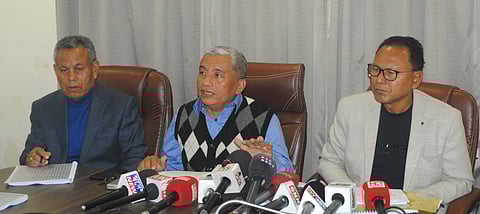
Addressing the media, CCTOA said the recommendations, made by a consultative group chaired by Suhas Chakma, violate constitutional principles and threaten the political and reservation rights of existing Scheduled Tribes in Assam.
CCTOA stated that under the Constitution of India, Scheduled Castes (SCs) and Scheduled Tribes (STs) are distinct categories, with ST identification based on specific tribal characteristics as outlined by the Lokur Committee Report (1965). The six communities, the committee argued, do not meet these criteria. The organization recalled that in 1993, after research by the Assam Institute of Research for Tribals and Scheduled Castes, the Assam government had recommended these six communities as Other Backward Classes (OBCs)—a classification later notified by the National Commission for Backward Classes.
“Once notified as OBCs, they cannot be reclassified as Scheduled Tribes for political expediency,” Chief Coordinator of CCTOA Aditya Khakhlari asserted.
CCTOA highlighted that every major committee since Independence has opposed granting ST status to Tea and Ex-Tea Garden Tribes. Citing the Bordoloi–Thakkar Committee report (1947) and the Lokur Committee (1965), the organization said tea garden labourers were categorically excluded from the ST list.
The Committee also objected to the grouping of Koch and Rajbongshi communities, stating they are distinct social groups. It noted that Koch were identified as Scheduled Castes in West Bengal under the 1950 SC order and therefore cannot be classified as STs in Assam.
According to CCTOA, Tai Ahoms, Chutiyas, Morans, and Mataks are part of the mainstream Assamese society and were never included as Scheduled Tribes in either the 1950 Constitution (ST) Order or the Lokur Committee report, making their present inclusion untenable.
CCTOA questioned the neutrality of expert committees whose members, it said, were nominated by organizations of the claimant communities themselves. It pointed out that even when an ethnographic committee recommended SC status for 38 out of 74 tea communities, the Assam government proposed ST status for all 74, contrary to expert findings.
The organization alleged that the demand for ST status is driven mainly by the desire for political reservation in Panchayats, Autonomous Councils, Autonomous District Councils, the State Assembly, and Parliament, as OBCs have no seat reservation in the Assam Assembly. It added that these communities already enjoy 27% OBC reservation and have separate autonomous or development councils.
CCTOA warned that granting ST status to the six communities would severely dilute and destroy the political reservation of existing STs at all levels, including Lok Sabha seats. Reserving only the Kokrajhar and Diphu parliamentary seats, it said, cannot justify such widespread erosion of rights.
The organization flagged that Assam’s current reservation stands at 59%, exceeding the 50% ceiling laid down by the Supreme Court in the Indra Sawhney judgment (1992). Inclusion of more communities in the ST list could push reservation beyond 70%, which would be “absolutely unconstitutional,” it said.
CCTOA concluded that the recommendations contradict even the assurance given by an all-party delegation of the Assam Legislative Assembly that existing ST rights would not be affected.
“Since the current proposal directly harms the political and constitutional rights of existing Scheduled Tribes, the recommendations are being outrightly rejected,” stated Aditya Khakhlari.
Also Read: Mass UPPL Resignations in Bijni Over ST Status Concerns
