
- Home
- Live Blog
- Breaking News
- Top Headlines
- Cities
- NE News
- Sentinel Media
- Sports
- Education
- Jobs
Staff Reporter
GUWAHATI: The Assam government has finally declared snakebite as a notifiable disease. With this declaration, a mechanism has been established requiring all public and private hospitals, medical colleges, clinics, and other health institutions to legally report every suspected, probable, or confirmed snakebite case and related death to health authorities.
The central government directed all states to declare snakebites as a notifiable disease back in 2024. This change will help record how well treatments are working, manage supplies of anti-snake venom serum, and improve awareness about prevention and getting medical help on time.
The notification of the State Health and Family Welfare Department said, "Snakebites cause substantial morbidity and mortality, particularly among vulnerable populations such as agricultural workers, children and people residing in snake-endemic regions. Despite the magnitude of this issue, snakebite cases and deaths are often underreported and do not receive adequate public attention. Declaring snakebites as a notifiable disease is expected to strengthen surveillance, improve data collection and reporting, facilitate timely treatment and resource allocation, and support preventive and clinical management measures."
According to sources, Assam witnessed over 10,000 snakebite cases in 2024 and over 11,000 in 2025. Taking the increasing number of snakebite cases into account, the government under the National Health Mission (NHM) trained around 5,000 doctors and nurses for treatment and diagnosis of snakebites since 2024. In addition to these efforts, the ICMR (Indian Council of Medical Research) opened a 24x7 helpline number-9957875108-for reporting snakebite cases.
Regarding anti-venom medicines and accessories for treatment, sources said that all CHCs (community health centres), district hospitals, sub-divisional hospitals and all medical colleges and some selective primary health centres (PHCs) have such medicines available.
According to sources, before medical treatment, movement of the patient needs restriction that slows down the spread of venom to the lymphatic system: washing the bite area gently with clean water, wrapping a clean, dry and loose bandage over the bite area to keep it protected, and trying to recall the snake's size, colour, etc., to describe it to the doctor.
The don'ts include avoiding cutting the wound, applying ice, or using a tourniquet, and avoiding medication from quacks.
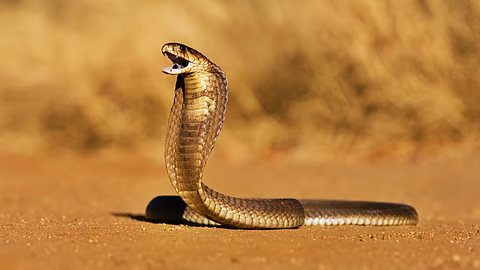
According to official sources, snakebites have become a major public health concern in Assam. Bio-diverse Assam is home to many snake species, some of which are highly venomous. Fatalities are due to delayed medical intervention and the lack of awareness of proper first-aid measures.
Also Read: Assam: Demow Model Hospital Treats 4,000 Snakebite Victims, Marks Major Milestone
