
- Home
- Live Blog
- Breaking News
- Top Headlines
- Cities
- NE News
- Sentinel Media
- Sports
- Education
- Jobs
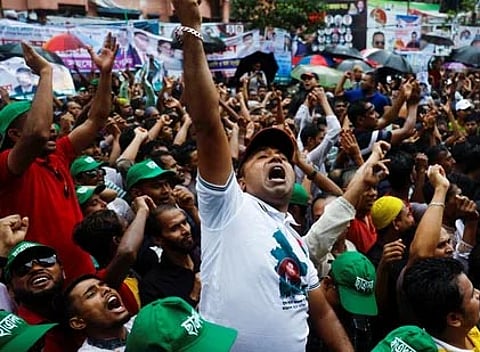
New Delhi: The campaign for the February 12 Bangladesh elections ends today. The country, following the ouster of Sheikh Hasina, has descended into chaos, and minority Hindus have borne the brunt of radical Islamists who, critics say, have been given a free hand by the Muhammad Yunus-led interim government.
Interestingly, Hindu votes are proving to be crucial in these elections. Both Jamaat-e-Islami and the Bangladesh Nationalist Party (BNP) have been reaching out to the Hindu community. Experts say the Hindu vote may ultimately prove to be the swing factor in a closely contested election.
For Hindus in Bangladesh, safety remains the utmost priority. Over the past year, atrocities against them have surged, with brutal killings being filmed and clips circulated widely. Human rights groups have flagged the violence, stating that the killings are targeted and institutionalised in nature. Hindus, whose population has dropped drastically over the last couple of decades due to persecution, have been pleading with the establishment for protection. They want their properties to be safeguarded from destruction or illegal seizure. They also want an end to the rape of women and the ruthless killing of men.
Both Jamaat and the BNP have understood the importance of the Hindu vote and realise that in a tightly contested battle, it could be decisive. Opinion polls indicate a close fight between the BNP and Jamaat. Initially, most polls predicted a walkover for the BNP. However, Jamaat, which enjoys the backing of Yunus, has managed to bounce back and, along with its allies, is now within touching distance. During their campaigns, both parties have visited temples and praised Hindus in an attempt to woo the community.
During the campaign, Jamaat in particular has praised Hindus extensively. Its candidates have said that Hindus have played a major role in education and in funding educational institutions. Jamaat leaders have acknowledged that the role of Hindus in spreading education in the region cannot be denied. Both the BNP and Jamaat have assured the Hindu community of safety and security.
Bangladesh watchers say that despite outreach from both sides, the Hindu vote is more likely to go to the BNP. Jamaat has a hardline image and is viewed as radical in its ideology. It is also perceived as anti-India, a factor that could work against it in securing Hindu votes.
Moreover, Hindus tend to trust the BNP more than Jamaat. Many in the community believe that Jamaat has played a significant role in their persecution. There have also been several instances where Jamaat either backed such persecution or remained silent when it occurred.
Experts say that when all these factors are considered, the BNP enjoys an edge among Hindu voters. Additionally, in 2013, the International Crimes Tribunal indicted several Jamaat members for war crimes against Hindus during the 1971 Bangladesh atrocities.
This outreach also comes at a time when the persecution of Hindus continues in Bangladesh. Neither party has been able to stop it, making the community cautious before casting its vote.
According to the 2001 Bangladesh census, there were around 11.8 million Hindus in the country, constituting 9.6 per cent of the population. The 2011 census recorded approximately 12.73 million Hindus out of a total population of 149.7 million. The latest census, conducted in 2022, stated that out of 165.1 million people, 13.1 million are Hindus, meaning they now account for 7.95 per cent of the population.
Bangladeshi Hindus are scattered across most regions except Narayanganj, which limits their ability to unite for political representation. However, they have emerged as swing voters in multiple elections due to consistently high voter turnout. Traditionally, Hindus have supported the Awami League. Now, in the absence of Sheikh Hasina’s party, experts say the Hindu vote is most likely to tilt in favour of the BNP. (IANS)
Also Read: Cyber abuse, threats shadow women candidates in Bangladesh elections
