
- Home
- Live Blog
- Breaking News
- Top Headlines
- Cities
- NE News
- Sentinel Media
- Sports
- Education
- Jobs
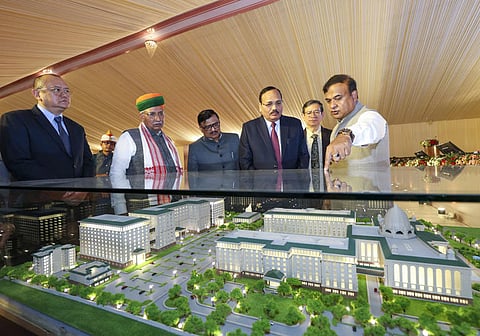
Guwahati: Chief Justice of India (CJI) Justice Surya Kant has laid the foundation stone for a new integrated Judicial Court Complex at Rangmahal in North Guwahati, marking a significant step towards modernising judicial infrastructure in the Northeast.
The project, envisaged as a full-fledged judicial township, has, however, drawn opposition from the Gauhati High Court Bar Association (GHCBA), which continued its protest against the proposed relocation of the High Court.
The proposed campus, spread across 148 bighas (around 49 acres) in Kamrup district, is planned as the principal seat of the Gauhati High Court, which has jurisdiction over Assam, Arunachal Pradesh, Mizoram and Nagaland. Phase I of the project is estimated to cost about Rs 479 crore.
Addressing the gathering after laying the foundation stone, the CJI expressed surprise over the protests and said opposition based on personal inconvenience should not come in the way of long-term institutional development. “Those opposing the new court complex are either ill-informed or not realising the needs of new members of the Bar. Personal vested interests should not be valid grounds for opposing infrastructure meant for the future,” Justice Kant said.
Describing the project as forward-looking, he said the integrated Judicial Court Complex is designed to meet future aspirations of the judiciary. He added that the Rangmahal site was strategically chosen and would bring all essential judicial facilities under one roof, helping improve efficiency and access to justice.
Assam Chief Minister Himanta Biswa Sarma and Union Minister for Law and Justice Arjun Ram Meghwal were present at the ceremony, along with judges of the Supreme Court and various High Courts. Several senior officials and dignitaries also attended the event.
According to officials, once completed, the complex will house the principal bench of the Gauhati High Court, district court buildings, High Court offices, and dedicated Bar facilities. The plan also includes parking spaces for around 900 cars and 400 two-wheelers. All buildings will be interconnected through bridges and equipped with modern security systems, fire safety arrangements and disaster-resilient features.
Meanwhile, the Gauhati High Court Bar Association boycotted the foundation-laying ceremony and continued its four-hour hunger strike outside the existing High Court building at Uzan Bazar. The association has opposed shifting the court from its present location, calling it the “heart of the city,” and has alleged that the decision was taken unilaterally by the government. GHCBA leaders have said they are considering legal options to challenge the project.
The Gauhati High Court currently functions from Uzan Bazar in central Guwahati, where both the historic court building and a newer multi-storey structure stand on opposite sides of Mahatma Gandhi Road. The State government has cited congestion and urban redevelopment, including plans for a Brahmaputra riverfront project, as reasons for relocating the court complex.
