
- Home
- Live Blog
- Breaking News
- Top Headlines
- Cities
- NE News
- Sentinel Media
- Sports
- Education
- Jobs
Our Correspondent
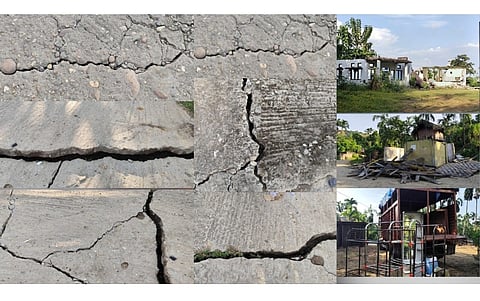
Digboi: With ground fissures spreading across residential premises and roads at Jharna Basti in Ledo under Margherita co-district in Tinsukia district, geological expert Prof Sarat Phukan of Gauhati University's Department of Geological Sciences has visited the affected locality, while North Eastern Coalfields (NEC), under Coal India Limited, is pressing other agencies to undertake a comprehensive scientific survey to establish the underlying causes of the alarming development.
Updating The Sentinel on Friday evening, Margherita co-district commissioner KN Chandana Jahnavi confirmed that Phukan had visited the site soon after the issue came to light. She said efforts were also underway to involve other agencies in the survey and study of the affected area.
Emphasising that the investigation was still at a preliminary stage, the co-district commissioner said the expert opinions and findings emerging from the proposed study and survey would be communicated subsequently. It was too early, she cautioned, to ascertain the exact causes without a scientifically substantiated assessment.
The clarification assumes significance amid growing apprehension among residents, with around 100 families reportedly affected by cracks in houses, courtyards and roads.
Several households have reportedly moved to safer locations, fearing that further ground movement could aggravate the damage.
Meanwhile, Margherita MLA Bhaskar Sharma visited the affected locality on October 2, accompanied by officials of the co-district administration and NEC representatives. During the inspection, Sharma assured residents that the matter would be pursued seriously and that geological experts would be engaged to assess the situation.
Residents have alleged that coal dumping and associated activities in the vicinity may have contributed to the ground deterioration. Concerns have also been raised over possible changes in natural drainage and underground water movement. However, these allegations remain unverified, and no scientifically established finding has yet identified the cause of the fissures.
The locality's proximity to the Ledo coalfield has brought mining-related activities and coal-waste disposal practices under scrutiny. A comprehensive investigation would need to examine geological formations, drainage patterns, nearby coal-waste deposits and relevant mining operations before drawing any conclusions.
The matter has also attracted the attention of the International Human Rights Council, which has sought an independent technical investigation and measures to address the concerns of affected residents, according to media reports published earlier this week.
For the affected families, the immediate concern is the safety of their houses, while the administration's emphasis is on establishing the facts through scientific investigation rather than speculation.
The proposed multi-agency survey to be engaged by Coal India Authority is expected to provide a clearer understanding of the extent of ground instability and the factors responsible for the damage. Its findings will be crucial in determining the remedial measures required and whether any mining-related or other human activities have contributed to the situation.
Until the technical assessment is completed, the administration faces the twin challenge of addressing immediate safety concerns and ensuring that the investigation produces credible, evidence-based conclusions.
Also Read: Gauhati HC seeks action-taken reports on encroachments in Behali, Singlijan reserve forests
