
- Home
- Live Blog
- Breaking News
- Top Headlines
- Cities
- NE News
- Sentinel Media
- Sports
- Education
- Jobs
Dharamshala: Soon after China approved the construction of the world’s largest hydropower project on the Brahmaputra River, also known as the Yarlung Tsangpo in Tibet, the Tibetan experts in exile have said that it will have multiple implications not only for India but for many other South Asian countries as well.
While speaking with ANI, Tempa Gyaltsen, deputy director and a researcher of the Tibet Policy Institute in Dharamshala, said, “This will have serious implications for India. The idea of this dam came up in 2020 when I personally wrote an article called ‘China’s super dam in Tibet and its implications for India,’ and now it has been officially approved, which means the construction is going to move forward very quickly.”
Gyaltsen added, “And the implication for India could be at different levels. For the people in Northeast India, the construction of a dam could have serious hydrological implications. I will give a few examples. In the summer, when there is an excess flow of water in the region, the dam that would store extra water will also be released, which means the chances of a greater flood in the region are very high. During winter, when there is a dry season in the region, when there is a scarcity of water flow in the region, the dam will store whatever river is flowing through the region, which means the region would face the scarcity of water in the region. So in either way, it’s a big, big loss for the Indian community in the northeast region.”
Speaking on other issues, Gyaltsen said, “Another issue that India would face is that we all know that the Himalayan region is highly sensitive to seismic activities, and scientifically, it has been proven that mega dams do induce seismic activities, which means that such a huge dam that China has purposed to be built on Yarlung Zangbo that we call in Tibet and which is called Brahmaputra as it enters India would surely have serious implications...”
Gyaltsen also pointed out that in situations when relations between India and China are not good, China can use the dam in ways that would create problems for India.
He said, “And then the third implication that could be more political is that China might use the dam for various reasons. If China has a good relationship with India, it might use it as a good thing; the management of the river flow might be used amicably as per the relationship at that point in time, but if the relationship between the two major powers can fluctuate... and if the relationship between India and China deteriorates or, at some point, the term gets unfavourable to each other, the Chinese government could easily use the dam strategically in either way. If there is a war between India and China, they could certainly release river water from the dam and cause floods in the region, or they can just store up the water to cause drought in the region. So these are the issues I am sure the government of India understands clearly, as they have also put up a statement, but the government of India and the strategic thinkers of India need to take it very seriously.”
Meanwhile, Dolma Tsering, deputy speaker of the Tibetan parliament in exile, told ANI, “Whenever Indian parliament convenes, we go to Delhi and reach out to the honourable members of Indian parliament to talk on the severity of how things are going on in Tibet, and that could impact not only India but the whole South Asian countries that are getting benefits from rivers originating from Tibet. So now we hear that China is making the largest dam in the world, and Tibet is a seismically prone area, so if such a dam gets destroyed by an earthquake, what are the repercussions we are going to have?”
Tsering added, “...I think it's high time not only India but all the South Asian countries that are impacted by the building of this dam should stand up...”
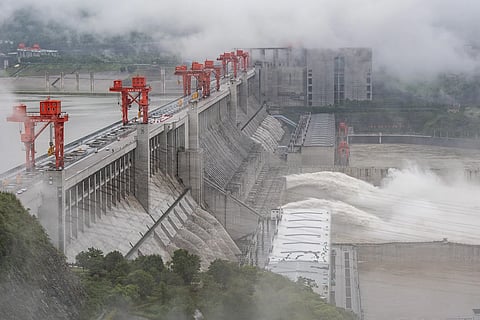
Notably, according to the reports, China is planning to build the world's largest dam on the Brahmaputra River in Tibet close to the Indian border. The planned construction of the dam has raised concerns in lower riparian countries, including India. (ANI)
Also Read: India urges China to ensure dams on upstream Brahmaputra don’t harm downstream regions
Also Watch:
