
- Home
- Live Blog
- Breaking News
- Top Headlines
- Cities
- NE News
- Sentinel Media
- Sports
- Education
- Jobs
The Ministry of Ports, Shipping and Waterways has described the four Brahmaputra lighthouses as the beginning of a wider national programme to equip India's inland waterways with the same navigational safety standards that have long governed its coastline.
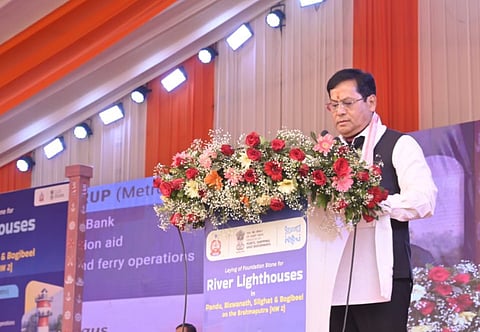
NW-2, passing through the heart of India's Northeast, is one of the country's most important inland cargo and passenger corridors — and the lighthouses are expected to significantly enhance its operational capacity and safety.In a first for India's inland waterways, Union Minister of Ports, Shipping and Waterways Sarbananda Sonowal on Thursday laid the foundation stones for four river lighthouses along the Brahmaputra at a ceremony held at Lachit Ghat in Guwahati.
The lighthouses will be the first of their kind on any inland waterway in the country, bringing coastal-grade navigational safety infrastructure to the Brahmaputra — designated as National Waterway-2.
Also Read: Lighthouses to Be Developed as Tourism, Cultural Hubs: Sonowal
The four sites are located at strategic points along the Brahmaputra's 891-kilometre navigable stretch, which runs from Dhubri to Sadiya — the longest navigable stretch of any Indian waterway.
The locations are Bogibeel in Dibrugarh, Pandu in Kamrup (Metro), Silghat in Nagaon, and Biswanath Ghat in Biswanath. The combined project outlay for all four lighthouses stands at approximately Rs 84 crore.
Speaking at the foundation stone laying ceremony, Sonowal framed the project as a statement of intent about India's approach to its river economy.
"Inland waterways are not merely an alternative to roadways and railways, but they are being energised and enabled as a force multiplier for our economy. A tonne of freight moved by water costs a fraction of what road transport demands, generates a fraction of the carbon, and frees our highways for passengers and time-sensitive goods," he said.
He added that the lighthouses will enable 24x7 safe navigation on the Brahmaputra, accommodate weather observation sensors, and provide the navigational infrastructure needed for sustained growth in both freight and passenger movement on the river.
"These lighthouses on the Brahmaputra are a statement of intent: that India's rivers are open for business round the clock," Sonowal said.
A Memorandum of Understanding between the Inland Waterways Authority of India (IWAI) and the Directorate General of Lighthouses and Lightships (DGLL) was signed on April 8, 2025, covering all four sites.
The sites were formally transferred to DGLL under Right of Use agreements in June 2025, following a technical proposal placed before the Central Advisory Committee for Aids to Navigation. Each lighthouse is scheduled for completion within 24 months of the award of contract, after geotechnical investigations, topographic surveys, and detailed design work are completed.
The Ministry of Ports, Shipping and Waterways has described the four Brahmaputra lighthouses as the beginning of a wider national programme to equip India's inland waterways with the same navigational safety standards that have long governed its coastline.
NW-2, passing through the heart of India's Northeast, is one of the country's most important inland cargo and passenger corridors — and the lighthouses are expected to significantly enhance its operational capacity and safety.
