
- Home
- Live Blog
- Breaking News
- Top Headlines
- Cities
- NE News
- Sentinel Media
- Sports
- Education
- Jobs
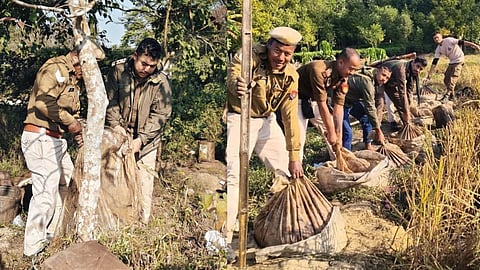
Jorhat: In a serious setback to the illicit liquor business, Jorhat Police on Thursday confiscated 20,000 litres of illicit country liquor popularly known as ‘Sulai’ during a massive operation undertaken in the Teok area of the district. The operation also resulted in the demolition of 10 distilleries that were used to make illicit liquors, as well as a huge stock of raw materials used to make such alcohol.
Police authorities clarified that the raid was conducted to demolish the whole value chain involved in the illegal business. During the raid, the police retrieved 70 to 80 large plastic sacks containing molasses, reportedly stored underground, and 30 to 35 drums of ‘Sulai’. This showed that the illegal brewing activity was well-organised in the region.
Moreover, Jorhat Superintendent of Police Subhrajyoti Borah states, "This is an initial drive to intensify enforcement action against illicit liquor establishments. These drives will continue over the next few days, and several vulnerable areas already stand short-listed to conduct these raids." He further adds, "It is a necessary drive to ensure that these illicit establishments are fully erased."

Furthermore, Sulai is a transparent and colourless liquid traditionally made from the fermentation of molasses or rice, has long been an important cultural drink in some regions of Assam. Yet the government has repeatedly maintained that the unregulated but illicit production of Sulai is fraught with serious health dangers. Illicit distillers normally use methanol to make the drink stronger and thus more valuable by making it a potentially deadly drink.
This move by the police is against the backdrop of the 2019 Assam hooch tragedy, which claimed at least 158 lives, mostly tea garden labourers in the Golaghat and Jorhat districts of the state, who had consumed Sulai. Ever since the tragedy, the police have been making earnest efforts to check the illegal manufacturing and sale of liquor.
However, despite knowing the dangers, the affordability of illicit Sulai compared to licensed alcohol makes it particularly attractive to daily wage earners and tea garden labourers, who consumed it despite potentially fatal health consequences. People are not even aware that toxic materials are mixed with the drink during illegal brewing.
Police authorities reiterated their statements that strict action would be maintained in the state of Assam in a similar fashion to recent ones in the districts of Sivasagar, as part of their plan to prevent any future tragedies associated with illicit liquor consumption.