
- Home
- Live Blog
- Breaking News
- Top Headlines
- Cities
- NE News
- Sentinel Media
- Sports
- Education
- Jobs
A CORRESPONDENT
DIGBOI: In apparent violation of recent directions issued by the Supreme Court of India to decongest national highways and eliminate accident-prone practices, long queues of oil tankers and heavy vehicles continue to choke NH-38 across Assam’s Tinsukia district, turning key stretches into potential death traps.
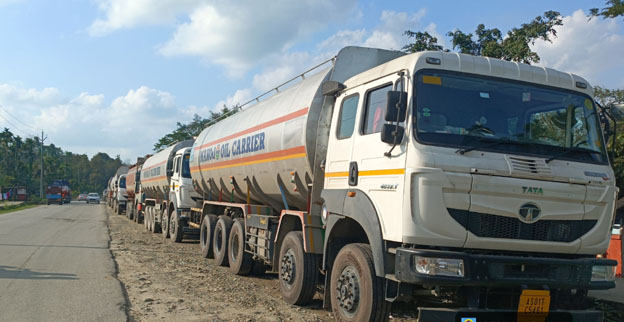
A ground survey by The Sentinel on Tuesday exposed widespread and systematic roadside parking along the highway. Over 50 oil tankers were found stationed in a nearly 250-meter-long queue between the Digboi–Margherita Railway Station tri-junction near Digboi Club and the AOD Effluent Treatment Plant— an already vulnerable stretch marked by sharp turns and heavy traffic movement.
Similar scenes were observed at Bogapani, from Tingrai Station to the NRL petrol pump, and further towards Makum, pointing to a larger, unchecked pattern across NH-38.
Most of the vehicles are oil tankers waiting for fuel loading at the AOD Golai Oil Terminal under Digboi Police Station. Parked along the carriageway, shoulders, and in several cases on the wrong side of the road, these hazardous carriers pose a constant threat to commuters. Residents of Digboi and Margherita have expressed concern over the situation, cautioning that a significant accident is imminent.
The situation runs contrary to the apex court’s recent mandate aimed at improving highway safety nationwide. Among its key objectives, the court has prohibited parking of heavy vehicles on highways and shoulders, allowed halting only at designated lay-bys and authorised zones, and ordered the removal of all unsafe roadside encroachments, including unauthorised commercial activity such as dhabas within the right of way.
It has further called for strict enforcement through district-level highway safety task forces, use of monitoring systems, and coordinated action to ensure highways do not turn into “corridors of peril”, while affirming road safety as part of the fundamental right to life under Article 21.
On the ground, however, enforcement appears uneven. Speaking to The Sentinel, a senior official of the crime branch of Assam Police said that instructions have already been issued to impose fines and initiate legal action against traffic violations. The official acknowledged that while the department has received the Supreme Court directions, it is awaiting further technical clarity and formal government orders for stricter implementation, though routine enforcement mechanisms remain in place.
The spotlight has also turned on Assam Oil Division (AOD), as the congestion is directly linked to operations at its Golai terminal. Drivers allege that, despite having adequate space within the facility, the parking system remains poorly managed. “We have raised the issue multiple times, but there is no proper streamlining,” a driver said, explaining why tankers are forced to queue along the highway.
The failure to accommodate operational vehicles within designated premises raises serious questions of accountability, particularly amid rising highway accidents. The presence of fuel-laden tankers along narrow and accident-prone stretches not only disrupts traffic flow but significantly heightens the risk of catastrophic incidents.
Compounding the concern, incidents of oil pilferage have also been reported from the stationary tankers, allegedly taking advantage of the prolonged queues and lack of monitoring, pointing to serious security lapses.
With violations continuing across multiple stretches of NH-38, the gap between judicial directives and ground-level implementation remains stark. As the Supreme Court of India pushes for safer and more disciplined highways across the country, the unfolding situation in Tinsukia raises a critical question—who will be held accountable if these hazardous conditions lead to loss of life.
Also Read: Centre releases Rs 1,000-crore addl funds for NH projects in NE
