
- Home
- Live Blog
- Breaking News
- Top Headlines
- Cities
- NE News
- Sentinel Media
- Sports
- Education
- Jobs
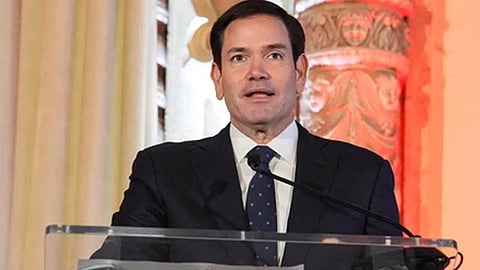
Washington DC: US Secretary of State Marco Rubio on Sunday defended Washington's military action in Venezuela, during which it captured the country's president and deposed dictator Nicolas Maduro and his wife, saying that it was aimed at protecting US national interests in the Western Hemisphere and preventing adversaries from controlling the South American country's oil resources.
Speaking on NBC News's Meet the Press, Rubio emphasised that the strike was not about seizing oil for the United States but about preventing adversaries from controlling it, particularly noting China and Iran.
"The first steps are securing what's in the national interest of the United States and beneficial for the people of Venezuela, and those are the things that we are focused on right now. No more drug trafficking, no more Iran or Hezbollah presence there, and no more using the oil industry to enrich adversaries around the world--while not benefiting the people of Venezuela. This must, frankly, benefit the United States and the region," Rubio said while speaking to NBC News.
"We don't need Venezuela's oil. We don't want oil to be controlled by adversaries of the United States. Why does China need the oil? Why does Russia need their oil? Why does Iran need theirs? This is the Western Hemisphere, where we live. We will not allow it for adversaries, competitors, and rivals of the United States. We want to see the oil and the proceeds benefit the people of Venezuela. They will not come out of our hemisphere, destabilise our region in our own backyard, and have us pay the price. Not with President Trump," he added.
According to the Times of Israel, Iran has maintained a long-standing alliance with Venezuela, using the country to circumvent sanctions and trade oil for gold to finance its armed groups. Additionally, Iran-backed terrorist group Hezbollah has established extensive support networks in Venezuela, generating funds through connections with drug traffickers.
Meanwhile, China is the largest buyer of Venezuelan oil. Import Globals' China Import Export Trade Data shows that China remains the largest buyer of Venezuelan crude, accounting for roughly 85 per cent of the country's total exports.
Rubio also dismissed comparisons with past US interventions in Iraq, Libya, and Afghanistan, noting that many experts advising critics were focused only on the Middle East and had limited knowledge of Venezuela or the Western Hemisphere, adding that the operation was carefully planned and aimed at a strategic outcome.
"These are people who have focused their entire careers on the Middle East because that's where all of the action was. Very few of them know very little about Venezuela and the Western Hemisphere. Venezuela looks nothing like Libya. It looks nothing like Iraq, nothing like Afghanistan, and nothing like the Middle East--other than the Iranian agents running through and plotting against America," he said.
He also expressed optimism for Venezuela's future under US oversight.
"We all wish to see a bright future for Venezuela and a transition to democracy. These are things we still care about. What happens over the next two or three weeks and two or three months, and how that ties to the national interest of the United States. We hope this leads to a holistic direction. We're in favour of all of that," he said.
This comes after Washington on Saturday carried out a "large-scale strike against Venezuela", and the deposed dictator, Nicolas Maduro and his wife, Cilia Flores, were captured and taken out of the country.
Maduro and Flores were captured in Caracas and flown out of the country in a joint operation involving intelligence agencies and US law enforcement.
Trump stated that Maduro and his wife have been indicted on charges of alleged "drug trafficking and narco-terrorism conspiracies" in the Southern District of New York and will face trial.
Earlier, US Secretary of War Pete Hegseth had defended Washington's military intervention in Venezuela, asserting that the operation was the "exact opposite" of the 2003 Iraq invasion and would not result in prolonged conflict or loss of American lives.
In an interview with CBS Evening News on Saturday (local time), Hegseth was asked about concerns among Americans who may have been reminded of past US interventions, particularly the Iraq war, which led to significant loss of life and resources.
Responding to concerns, Hegseth said the operation in Venezuela marked a complete departure from past military engagements, adding that the current strategy focused on achieving objectives without putting American troops at risk.
"It's the exact opposite. We spent decades and decades and spent, purchased in blood and got nothing economically in return. And President Trump flips the script," he said.
"Through strategic action, we can ensure that we have access to additional wealth and resources, enabling a country to unleash that without having to spend American blood," the Secretary of War added. (ANI)
Also Read: A recalibration moment: Marco Rubio's long view of US power
