
- Home
- Live Blog
- Breaking News
- Top Headlines
- Cities
- NE News
- Sentinel Media
- Sports
- Education
- Jobs
‘Patre tyagi, gune ragi, bhagi parijanaih saha, shastre boddha, rane yoddha’, RSS chief lists five traits of ideal leader
Mumbai: Rashtriya Swayamsevak Sangh (RSS) chief Mohan Bhagwat on Thursday spoke on a whole lot of issues, including caste-based reservations, Gen Z and Gen Alpha, essential qualities of visionary leadership, and India's relations with Pakistan and China in terms of civilian ties in the times of conflict and otherwise.
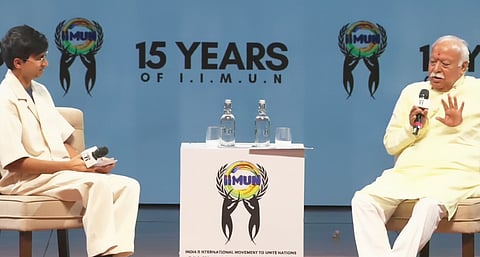
Bhagwat was speaking during an interactive session with over 2,000 youths from Gen Z and Gen Alpha at an event organised to mark the 15th anniversary celebrations of India's International Movement to Unite Nations (IIMUN).
The RSS chief described Gen Z and Gen Alpha as more honest than previous generations, saying that this honesty is essential for nation-building and patriotism.
On the quota system, Bhagwat stated that caste-based reservations in India must continue as long as social discrimination and inequality exist in society. He emphasised viewing the issue through the perspective of Dr B R Ambedkar to avoid friction and controversy.
The RSS chief addressed and interacted with more than 2,000 students representing Generation Z and Generation Alpha at the inauguration of the annual championship conference organised by India's International Movement to Unite Nations (IIMUN), which is celebrating its 15th anniversary.
During the session, IIMUN founder Rishabh Shah posed several questions to young participants regarding student protests at Delhi's Jantar Mantar, reservation policy, and key challenges facing the youth.
The interactive session on Thursday took place against the backdrop of protest organised in Delhi against the alleged NEET paper leak by the Cockroach Janata Party.
Emphasising the importance of engaging with the younger generation, Bhagwat noted, "What is 'Gen Z'? They are our own people. If they protest for a cause, how is that wrong? Their grievances ought to be heard. Just because Gen Z engages in a protest does not make them 'anti-country' or 'anti-national'."
When asked whether protesting itself is wrong, the RSS Chief said that protesting is fundamentally a form of dialogue.
Expressing dissatisfaction over political weaponisation of reservations, Bhagwat stated that reservation was originally designed as a tool to achieve social harmony. "The concept itself is not wrong, but those holding the sword are wielding it intentionally in the wrong direction," he remarked.
The RSS chief added that until this political mindset shifts, the situation will not improve, though effective implementation of welfare schemes could eventually reduce the need for quotas.
Addressing recent student demonstrations over issues like the NEET paper leak, Bhagwat noted that young people participating in protests or voicing concerns does not make them "anti-national". He expressed strong faith in Gen Z and offered thoughts on maintaining dialogue rather than suppressing student voices.
Commenting on the political discourse surrounding affirmative action, the RSS chief noted that politicisation disrupts the intended objective of reservation. "If the issue of reservation is implemented honestly, its necessity will end sooner, allowing for reconsideration. Unfortunately, because politics has entered the picture, it creates bitterness in society. Reservation is an important medium created to foster social unity and equality," he noted.
Expressing solidarity with the youth, Bhagwat remarked, "If I were to trust anyone blindly, I would blindly trust Gen Z."
"Just as we sit here and converse-where I understand your points and you understand mine-dialogue prevents conflict. If an issue remains unresolved, disputes arise. In a democracy, protesting is not wrong at all. There is nothing inherently wrong with protesting. However, it should not be utilised to create social divisions. The intention behind the protest by Gen Z was correct. Many reforms need to take place in India's education policy that are currently not happening, which is why it is being discussed. Therefore, dialogue is essential. What course to take if matters are not resolved through dialogue is a secondary question," he remarked.
He noted that protests are a natural form of communication within a democratic framework when grievances go unaddressed, adding that protesting is a valid form of dialogue aimed at system correction rather than opposing individuals.
Referencing to B.R. Ambedkar, Bhagwat noted that while expressing dissent is a Constitutional right, protests must strictly adhere to the guidelines set by the Constitution and should never be used to cause division.
Asked about India's relations with Pakistan and China in terms of civilian ties in the times of conflict and otherwise, Bhagwat said that in the times of conflict, "we have to go with whatever our government does".
"But that should not sever the ties which are already there. China's people say that for 2000 years, Bharat gave them some values; and Pakistan was Bharat less than 100 years ago. This should not be forgotten; these ties cannot be severed, they can be put on hold till there is conflict. But what is the Bharat solution? The Bharatiya solution is not conquering or obliterating others, but to form that harmonious, assimilating process. That requires dialogue. So, conflicts may halt all these relations but they cannot sever, they should not," he said.
The RSS chief said that sometimes after resolution of a conflict "we have to pick up from where we have left it and we have to continue".
During the interaction, the RSS chief anchored his definition of leadership in a traditional Sanskrit verse. "Patre tyagi, gune ragi, bhagi parijanaih saha, shastre boddha, rane yoddha," he said.
Bhagwat unpacked the verse into five actionable principles for modern leaders: Patre Tyagi (Generosity): A leader must give generously and support deserving individuals; Gune Ragi (Appreciation of Virtues): A leader must recognise, value, and foster good qualities and talents in others.; Bhagi Parijanaih Saha (Shared Success): Leaders must share all forms of gain--whether fame, success, or material resources--equally with their team and community; Shastre Boddha (Knowledge and Wisdom): A leader must possess deep knowledge, understanding the underlying principles and "science" of their domain and Rane Yoddha (Courage in Strife): When faced with challenges, adversity, or conflict, a leader must stand firm and act courageously as a warrior. (Agencies)
Also Read: Assam Flood Crisis Deepens 19 Days After Deluge, Homes and Livelihoods Lost
