
- Home
- Live Blog
- Breaking News
- Top Headlines
- Cities
- NE News
- Sentinel Media
- Sports
- Education
- Jobs
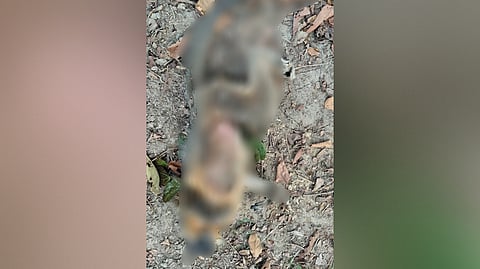
Kaziranga: Kaziranga witnessed a distressing incident on the last day of the year with the death of a rare capped langur (locally known as Tupimuriya Bandor) after it came in contact with an exposed electric wire near the Panbari Reserved Forest area. The incident has once again raised serious concerns over the safety of wildlife moving through human-dominated landscapes surrounding protected forest zones.
According to forest officials and wildlife experts, a troop of capped langurs has been regularly crossing through the area adjacent to the Methoni Tea Estate, located close to the Panbari Reserved Forest under the Kaziranga landscape. On December 30, while the troop was moving across the area as part of its usual route, one of the langurs accidentally touched an open electric wire and suffered severe electrocution injuries.
The injured animal was immediately rescued and rushed to the Centre for Wildlife Rehabilitation and Conservation (CWRC) at Kaziranga for emergency medical treatment. Despite the best efforts of veterinarians and wildlife caregivers, the langur succumbed to its injuries on December 31, casting a pall of gloom over conservation circles on the final day of the year.
Veterinary doctors at CWRC confirmed that the deceased capped langur was a female and was pregnant at the time of death. A post-mortem examination revealed the extent of internal injuries caused by electrocution, which ultimately proved fatal. The loss is considered particularly significant as capped langurs are listed as a vulnerable species and are already facing threats due to habitat fragmentation, human interference, and infrastructural hazards.
“This is not an isolated incident,” a CWRC veterinarian stated. “Similar cases have occurred earlier at the same location. Open and poorly insulated electric wires pose a serious threat to arboreal animals like langurs, which depend on tree canopies and elevated pathways to move safely.”
Wildlife experts point out that as forest corridors shrink and animal movement increasingly overlaps with tea gardens, villages, and infrastructure, the risk of such accidents continues to grow. Langurs, being tree-dwelling primates, are especially vulnerable to exposed power lines running close to treetops.
The veterinarian and forest officials have strongly requested the Methoni Tea Estate authorities to immediately coordinate with the electricity department to address the issue. They stated the need for proper insulation of power lines, rerouting of cables, or installation of underground wiring in sensitive wildlife movement zones to prevent further casualties.
Conservationists have also called for regular monitoring of wildlife corridors outside protected areas, stating that protection efforts should not be limited to national parks and sanctuaries alone. “Wild animals do not recognise human boundaries. Their safety depends equally on how responsibly we manage areas beyond forest limits,” an expert said.
The death of the capped langur has sparked renewed appeals for stricter wildlife-friendly infrastructure planning around Kaziranga, a UNESCO World Heritage Site renowned for its biodiversity. Authorities have been urged to treat the incident as a wake-up call and take immediate corrective steps to ensure that such tragic losses are not repeated in the future.
As the year ended on a sombre note, the incident served as a sharp reminder of the fragile coexistence between humans and wildlife, and the urgent responsibility to safeguard endangered species from preventable human-made hazards.
